
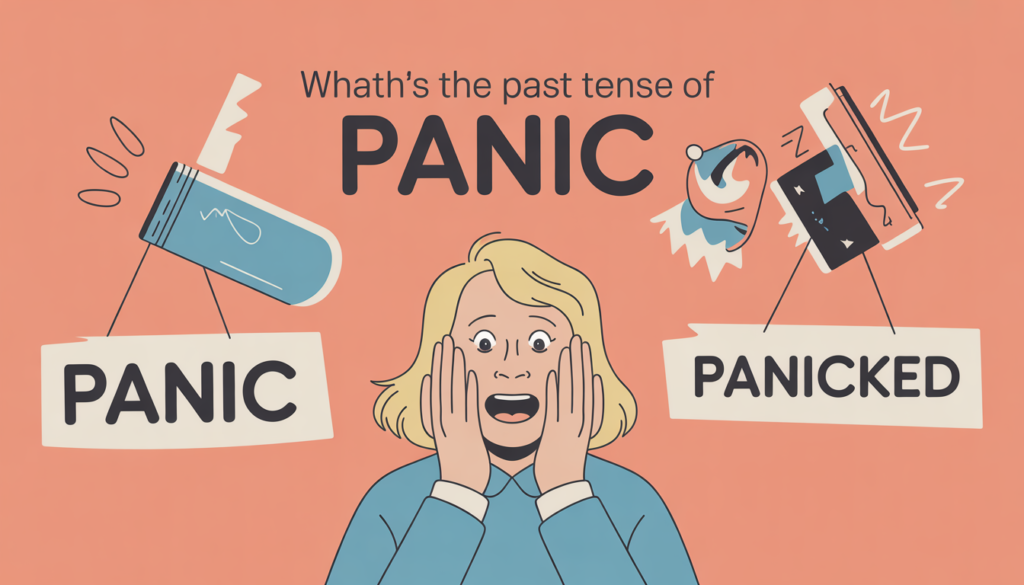
The past tense of panic is panicked — not panic, and definitely not some misspelled version like “panick” or “paniced.” This little grammar quirk trips up a lot of people, even native speakers, because the extra k feels unnecessary at first glance. But once you understand the rule behind it, everything clicks into place. Let’s break it down step by step so you can use these words confidently in writing, conversations, or even emails when you’re trying to explain why you freaked out yesterday.
What Does “Panic” Actually Mean?
Before diving into tenses, it’s helpful to get clear on the word itself. Panic comes from the Greek god Pan, who supposedly caused sudden, irrational fear in people (think wild, uncontrollable terror in the woods). Today, panic covers that sudden rush of fear or anxiety that makes rational thinking fly out the window.
As a noun, panic describes the feeling or situation:
- There was widespread panic in the stadium when the lights went out.
- She felt a wave of panic wash over her as the deadline approached.
As a verb, panic means to experience or cause that sudden fear:
- Don’t panic — we’ve got time to fix this.
- The loud bang made everyone panic and run toward the exits.
And as an adjective, we often use panicked (or sometimes panicky) to describe someone in that state:
- He had a panicked expression when he realized his wallet was gone.
- The panicky crowd pushed against the doors.
The Correct Past Tense of Panic: Why It’s “Panicked”
The short answer: panic is a regular verb, so its past tense follows the standard rule — add -ed. That gives you panicked.
But why the extra k? It protects the hard /k/ sound at the end of the word. Without it, “paniced” would look like it should be pronounced “pa-niced” (with a soft “s” sound, like “noticed”). English spelling rules kick in here: when a verb ends in -c (especially after a short vowel), you add k before -ed or -ing to keep the pronunciation consistent.
Think of similar words:
- Mimic → mimicked (not mimiced)
- Traffic → trafficked
- Picnic → picnicked
The rule isn’t about doubling the entire consonant randomly — it’s specifically about preserving the hard c sound when adding suffixes that start with e, i, or y. So panicked, panicking, and even panicky all get that protective k.
Common mistake alert: Some people write “panick” as the base or past form because it “feels” right phonetically. But that’s incorrect — stick to panic (present) and panicked (past).
Pronunciation Guide: Panic vs. Panicked
- Panic → /ˈpæn.ɪk/ (stress on first syllable, rhymes with “manic” or “Titanic”).
- Panicked → /ˈpæn.ɪkt/ (same stress, ends with a clear “kt” sound, rhymes with “picked” or “licked”).
Saying them out loud helps reinforce why the k matters — it keeps the crisp, sharp ending.
Verb Tense Overview for Panic
Here’s a quick table of how panic conjugates across major tenses:
- Present Simple: I/you/we/they panic; he/she/it panics Example: Crowds panic easily in emergencies.
- Present Continuous: I am panicking Example: Right now, I’m panicking about the exam tomorrow.
- Past Simple: I/you/we/they panicked Example: She panicked and forgot her lines on stage.
- Past Continuous: I was panicking Example: While everyone was panicking, he stayed calm.
- Present Perfect: I have panicked Example: I’ve panicked in interviews before, but I got better.
- Future Simple: I will panic Example: If the power goes out again, I will panic.
Panicked works as both the simple past tense and the past participle (used in perfect tenses).
Real-Life Scenario Examples: Panic vs. Panicked
One of the best ways to lock this in is seeing these words in everyday situations. Here are some relatable scenarios where people often mix them up.
Scenario 1: The Forgotten Wallet You leave a café and realize your wallet is missing.
- Correct: I panicked and ran back inside, heart racing.
- Incorrect: I panic and ran back inside. (This mixes present tense with past action — it sounds off.)
Scenario 2: Driving Mishap A car suddenly swerves into your lane.
- Correct: The driver panicked and slammed on the brakes too hard.
- Alternative: He was so startled he panicked and almost hit the curb.
- Wrong: He panic and slammed… (Again, tense mismatch.)
Scenario 3: Exam Pressure You’re in the middle of a test and blank on a question.
- Correct: I panicked for a second, but then took a deep breath and moved on.
- Better nuance: I started panicking when I saw the clock ticking down. (Here, panicking shows ongoing action in the past.)
Scenario 4: Group Reaction A loud noise in a crowded market.
- Correct: Shoppers panicked and started pushing toward the exits.
- Adjective use: The panicked shoppers created chaos in seconds.
- State vs. action: I was panicked by the sudden screams (more passive, emphasizing the cause).
Scenario 5: Job Interview Gone Wrong The interviewer asks a tough question you didn’t prepare for.
- Correct: I panicked and gave a rambling answer.
- Contrast: I was panicked by his follow-up questions (focuses on being overwhelmed by external factors).
These examples show how panicked marks a completed past action, while forms like was panicking describe ongoing fear at a past moment.
Common Confusions and Quick Fixes
- “I was panicked” vs. “I panicked”: Panicked (active) means you experienced the fear. Was panicked (passive) implies something caused you to feel that way. Both are grammatical, but the active version is more common in casual speech.
- “Panic” in past contexts: Never use the base form panic for past events — it stays present tense.
- “Panick”: This is a frequent typo. English doesn’t use it.
- Panicky (adjective): Means prone to panic, e.g., “He’s a panicky person in crises.”
Why Mastering This Matters
Little words like panic and panicked show up everywhere — news headlines, personal stories, emails, social media posts. Getting them right makes your writing sharper and more professional. Plus, once you spot the pattern (that protective k for -c verbs), you’ll catch similar issues in words like mimic, traffic, or frolic.
Next time you’re telling a story about that time the fire alarm went off or your phone died right before an important call, you’ll nail it: “I totally panicked.”
In short, the past tense of panic is panicked. Embrace the k — it’s there to keep things clear and correctly pronounced.