
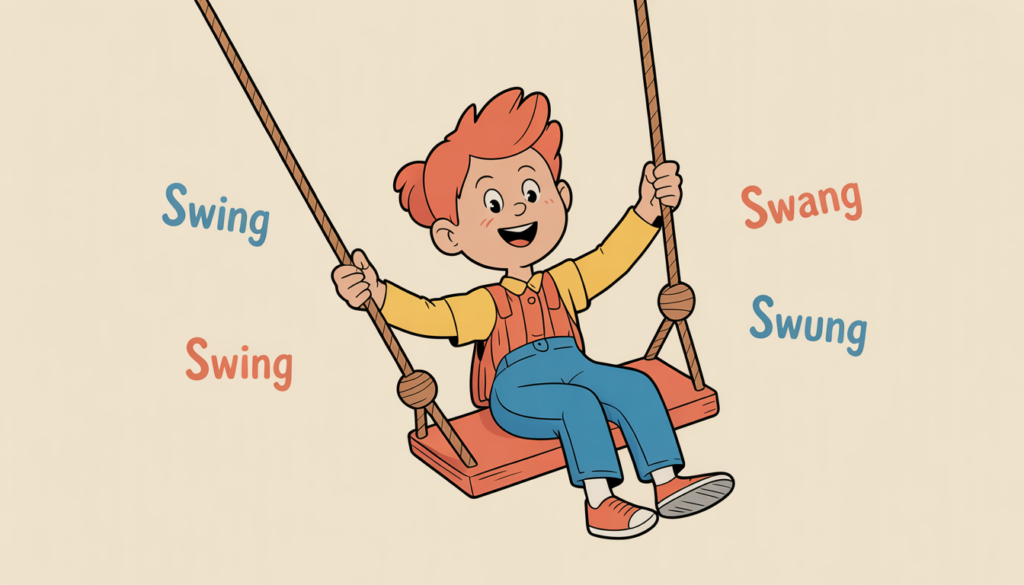
If you’ve ever paused mid-sentence wondering whether to say “I swang the bat” or “I swung the bat,” you’re not alone. This little irregular verb trips up plenty of native speakers, writers, and even some teachers. The short, clear answer in modern standard English is: the past tense of swing is swung. Not swang (which feels tempting to some), and definitely not swing repeated or some made-up form like swinged.
Swing stays the base form for present tense, while swung handles both the simple past and the past participle. Let’s dive into why this is the case, clear up the confusion with real scenarios, and give you practical examples so you never second-guess it again.
The Correct Forms: Swing – Swung – Swung
English irregular verbs don’t follow neat patterns, and swing is a classic example of one that merged its past forms over time. Major dictionaries agree:
- Merriam-Webster lists swung as the past tense and past participle.
- Cambridge Dictionary confirms: past simple and past participle = swung.
- Oxford Learner’s Dictionaries shows the same: past simple swung, past participle swung.
Swang appears in some entries as chiefly dialectal (like in parts of Scotland, northern England, or older American regional speech), or as an obsolete/historical form from Old English roots. In everyday standard English today—especially in writing, news, books, professional settings, or international communication—swung is the safe, accepted choice. Using swang might come across as folksy, outdated, or even incorrect to many readers.
Think of it like similar verbs: sing – sang – sung has three distinct forms, but swing simplified to two: swing – swung – swung, just like cling – clung – clung or fling – flung – flung.
Why the Confusion with “Swang” Persists
Historically, swing came from Old English swingan, with past swang and participle swungen. Over centuries, the forms leveled out, and swung won out for both past uses by the mid-20th century. You’ll still spot swang in older literature, some dialects, or casual speech (especially in jazz slang or regional accents), but it’s no longer standard.
In recent usage (2024–2026 sources, sports commentary, news, and grammar discussions), swung dominates overwhelmingly. Baseball announcers say “He swung and missed,” not “swang.” Journalists write “The pendulum swung back.” Even in creative writing tips from 2025, experts recommend sticking to swung for clarity.
Real-Life Scenarios: Seeing the Difference in Action
Let’s look at everyday situations where people debate or misuse these forms. I’ll show correct swung examples alongside why swang feels off (or dialectal) in context.
At the Playground or Park (Physical, Literal Swinging)
Picture a family day out:
- Correct: The kids swung on the tire swing until sunset, laughing the whole time.
- With “swang”: The kids swang on the tire swing… (sounds a bit old-school or regional; most parents posting photos would write swung naturally.)
- Scenario: A mom shares on WhatsApp or Facebook: “Little Ahmed finally pumped his legs and swung so high today!” Using swang here might make friends think it’s a typo.
Another one:
- Correct: She swung back and forth gently on the porch swing, sipping chai.
- Scenario in Pakistan or Sindh context: During a warm evening in Jacobabad, someone relaxes: “The breeze was nice, so I just swung on the charpai swing outside.” Swung fits perfectly in casual storytelling.
In Sports: Baseball, Cricket, Golf (Swinging a Bat or Club)
This is prime confusion territory—sports talk is full of “swing.”
- Correct: Babar Azam swung the bat powerfully and cleared the boundary for six.
- With “swang”: Babar Azam swang the bat… (rare in commentary; you’d almost never hear it on PTV Sports or in match reports.)
- Scenario: After a PSL match, a fan texts: “That last over was wild—he swung at everything and connected twice!” Swung sounds right to cricket lovers worldwide.
Golf example:
- Correct: The pro swung too hard and hooked the ball into the rough.
- Scenario: Friends discussing a round: “Yaar, I swung like a beginner today—lost three balls!” No one says swang in modern sports chats.
Metaphorical Swings: Opinions, Moods, or Trends
Swing often means a sudden change.
- Correct: Public mood swung toward the underdog candidate after the rally.
- With “swang”: Public mood swang… (feels awkward in news writing.)
- Scenario: In a 2026 election discussion: “Voter sentiment swung sharply after the debate—polls shifted overnight.” Journalists always use swung.
Another:
- Correct: The pendulum of fortune swung in our favor at the last moment.
- Scenario: Motivational talk: “When things look down, remember—the pendulum always swung back eventually.”
Perfect Tenses: Have/Had Swung
Here swung is non-negotiable as the past participle.
- Correct: I have swung by the market already—got fresh mangoes.
- Incorrect: I have swang by… (sounds completely wrong.)
- Scenario: Casual chat: “Have you ever swung on a giant swing at the mela?” Everyone defaults to swung.
Pronunciation: Helping Your Ear Decide
- Swing (present): /swɪŋ/ — short “i” like in “win,” nasal ng.
- Swung (past): /swʌŋ/ — “uh” like in “cup,” still ng.
- Swang (if used): /swæŋ/ — “a” like in “cat.”
Say aloud: “Today I swing, yesterday I swung, I have swung many times.” It flows smoothly. “Yesterday I swang” feels clunky for most speakers.
Quick Tense Table for Reference
- Present Simple: I swing / He swings
- Past Simple: swung
- Past Participle: swung
- Present Perfect: have swung
- Past Perfect: had swung
- Future: will swing
- Continuous (Past): was swinging
Tips to Lock It In Forever
- Pair it mentally with flung, clung, stung—all use u in past forms.
- Recall sports announcers: they say swung every game.
- If swang slips out in speech (especially in relaxed settings), no big deal—but switch to swung in emails, essays, or posts.
- Avoid forcing regular forms—no swinged (that’s a different verb meaning to whip or scold).
English quirks like this make the language colorful, but sticking to swung keeps you clear and professional. Next time the question comes up—“Is it swang or swung?”—you can confidently say: swung, every time in standard use.