
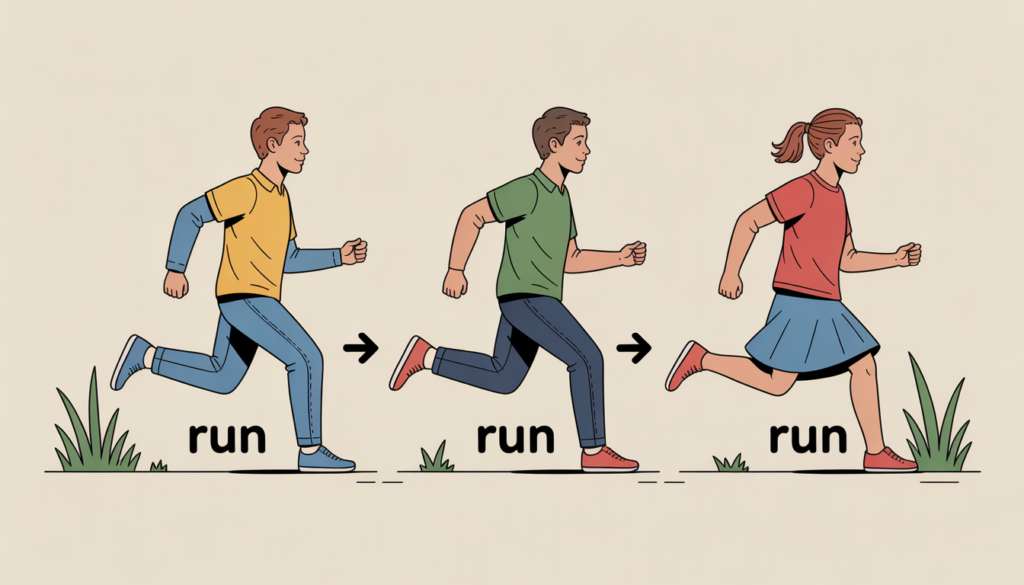
Understanding How “Run” Changes in the Past and Past Participle If you’ve ever paused mid-sentence wondering whether to say “I ran” or “I have run,” you’re not alone. The verb run is one of those sneaky irregular verbs in English that doesn’t play by the usual rules. Most verbs happily add -ed to form their past tense and past participle—like walk/walked/walked—but run does its own thing: run, ran, run.
Mastering these forms isn’t just about avoiding red squiggles in your writing; it makes your stories flow better, your emails sound more polished, and your conversations feel natural. Whether you’re chatting with friends, writing a school essay, or drafting a work report, getting run right builds confidence. Let’s walk (or should I say run?) through it step by step, with plenty of real-life examples so it sticks.
The Three Main Forms of “Run”
Every verb has principal parts, and for run they are:
- Base form (infinitive): run
- Past tense (simple past): ran
- Past participle: run
That’s it—no extra endings, no surprises. The past participle stays identical to the base form, which is what trips people up most often.
This pattern (run–ran–run) is classic for many high-frequency irregular verbs. Think of similar ones like come–came–come, become–became–become, or drink–drank–drunk (though drink has a different twist). Recognizing the pattern helps you spot when run behaves the same way.
Past Tense of “Run”: Always “Ran”
Use ran whenever you’re talking about a completed action in the past—no helping verbs needed. It’s the simple past tense, straightforward and independent.
Here are some everyday examples:
- Yesterday morning, I ran five kilometers before breakfast to clear my head.
- The kids ran to the park as soon as the bell rang.
- She ran into an old friend at the grocery store last week—talk about perfect timing!
- During the storm, water ran down the street like a river.
Notice how ran stands alone. You wouldn’t say “I run yesterday” or “I have ran yesterday”—those feel off because they break the tense rules.
In questions and negatives, it stays ran too:
- Did you run in the charity 5K last month?
- He didn’t run as fast as he used to after the injury.
Past Participle of “Run”: Stays “Run”
The past participle run only appears with helping verbs—specifically forms of have (have, has, had) for perfect tenses, or be for passive voice.
This is where the biggest confusion happens. Many people (even native speakers sometimes) slip and say “have ran” instead of “have run”. But remember: after have/has/had, you always need the past participle, which for run is run—never ran.
Correct examples:
- I have run out of patience waiting for the bus.
- She has run three marathons this year alone—talk about dedication!
- By the time we arrived, they had run out of food at the party.
- The program has been run successfully for over a decade.
Passive voice example:
- The race was run on a muddy track, making it extra challenging.
Incorrect versions you’ll see (and should avoid):
- ❌ I have ran five miles today.
- ❌ He had ran away before anyone noticed.
Why does this mistake happen? Ran feels “past-y,” so people reach for it. But grammar rules are strict here: have/has/had + past participle.
Using “Run” Across Different Tenses
To see the full picture, here’s how run shifts depending on the tense:
Present Simple
- I/you/we/they run every evening.
- He/she/it runs quickly.
Present Continuous
- She is running late again—typical!
Past Simple
- We ran to catch the train and barely made it.
Present Perfect
- They have run out of ideas for the project.
Past Perfect
- He had run the company for twenty years before retiring.
Future Simple
- Tomorrow, I will run my first half-marathon.
Present Perfect Continuous
- I have been running since dawn and I’m exhausted.
These examples show how ran locks into simple past completed actions, while run teams up with helpers for ongoing relevance or completion up to now.
Real-Life Scenario Examples to Make It Stick
Let’s put it into situations you might actually encounter.
Scenario 1: Talking about exercise or sports Correct: “Last weekend I ran 10 km in under an hour—personal best!” (Completed past action → ran)
Correct: “I have run that trail so many times I know every rock.” (Experience up to now → have run)
Scenario 2: Work or school deadline story Correct: “The team ran out of time and had to rush the presentation.” (Simple past → ran)
Correct: “By Friday, we had run through three different versions of the report.” (Past perfect for earlier completion → had run)
Scenario 3: Everyday mishap Correct: “The kids ran around the house like wild animals after eating sugar.” (Past simple → ran)
Correct: “Sorry I’m late—I have run into traffic.” (Present perfect for recent action affecting now → have run)
Scenario 4: Idiomatic uses
- “The campaign has run its course.” (finished naturally)
- “He ran for office twice but never won.” (past attempts)
- “We have run low on supplies—time to reorder.” (current state)
Common Mistakes English Learners (and Natives) Make
Even confident speakers mess this up sometimes. Here are the top pitfalls:
- Using ran after have/has/had: ❌ “She has ran the meeting perfectly.” → ✅ “She has run the meeting perfectly.”
- Forgetting the change in simple past: ❌ “Yesterday he run to work.” → ✅ “Yesterday he ran to work.”
- Mixing in passive: ❌ “The bill was ran through quickly.” → ✅ “The bill was run through quickly.”
- Overusing base form: Some learners stick to run everywhere to play it safe, but that makes past stories sound off.
Quick fix: When you see have/has/had, think “past participle = run.” When it’s just a finished past story, think “ran.”
Why Mastering This Matters
Small verb slips like “have ran” can make writing feel less professional or native-like. In job applications, academic papers, or even social media posts, precise tense use shows attention to detail. Plus, once you internalize run–ran–run, similar irregular verbs become easier—sing/sang/sung, swim/swam/swum, and so on.
Practice tip: Next time you journal or text about your day, deliberately use ran for yesterday’s actions and have run for experiences. Read it aloud—it helps train your ear.
Final Takeaway
The verb run follows a simple but strict pattern: run in the present/base, ran for simple past, and run again as the past participle with helpers. Nail this, and a huge chunk of English tenses clicks into place.
Keep practicing with your own sentences. Before long, choosing between ran and run will feel automatic—no second-guessing required. Your English will sound smoother, clearer, and more confident. And that’s worth every step (or sprint) along the way.