
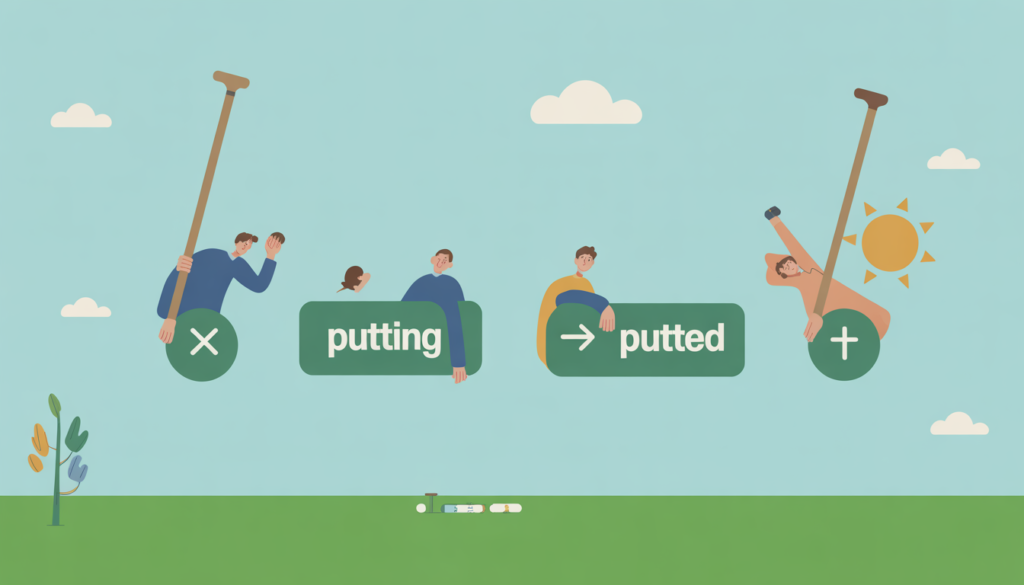
Understanding the Past Tense of ‘Putting’: Is it ‘Put’ or ‘Putted’? We’ve all been there: you’re telling a story about something you did yesterday, and suddenly you pause over a verb. Does it get an “-ed” like most words, or does it stay the same? One verb that catches people off guard is put — especially when it’s in the form putting. The question pops up constantly: in the past, is it put or putted?
The short, clear answer is put. That’s it — no extra letters, no drama. Put is one of those stubborn irregular verbs in English that refuses to follow the usual rules. In this article, we’ll break down why that’s the case, look at how the word behaves across tenses, share plenty of real-world usage examples, explain where the confusion comes from, cover the one niche situation where putted actually works, and give you solid tricks to never mix them up again. By the end, this little grammar puzzle should feel straightforward.
The Basic Rule: Past Tense of Put Is Always Put
Let’s start with the facts straight from reliable grammar sources like Cambridge Dictionary and major style guides: the past tense of put is put. The same goes for the past participle. Whether you’re talking about placing an object, arranging something, or using it in an idiomatic phrase, the form doesn’t change.
Here’s the conjugation lineup for quick reference:
- Base form (infinitive): put
- Present simple (3rd person): puts
- Present participle/gerund: putting
- Simple past: put
- Past participle: put
Examples make this crystal clear:
- Present: She puts the groceries away every evening.
- Past: Yesterday, she put the groceries away.
- Perfect: She has put the groceries away already.
No “-ed” ending ever appears when we’re using put in its standard sense of “to place” or “to position.”
Why Do People Want to Say “Putted”?
English has trained us to expect regular verbs to add “-ed” (or sometimes just “-d”) for the past: walk → walked, talk → talked, play → played. So when learners (and even some native speakers in casual moments) see put, their brain says, “Hey, this ends in a consonant — slap on that -ed!”
That overgeneralization is called overregularization — a super common stage in language learning. Kids do it all the time (“I goed to the store”), and adults slip into it with tricky irregulars. Putted feels logical… until you hear it out loud or see it written down. Then it just sounds off.
Other factors fuel the mix-up:
- Similar-sounding verbs like cut (cut/cut), hit (hit/hit), set (set/set) reinforce the zero-change pattern, but people forget put belongs in that club.
- Autocorrect or spell-check sometimes lets “putted” slide if context is missing.
- Non-native speakers applying blanket rules from their first language.
The truth? Putted is not correct in standard English for the verb put. Full stop.
Real-Life Usage Examples: Putting It into Practice
Seeing the word in sentences helps it stick. Here are everyday scenarios showing correct vs. incorrect forms.
Scenario 1: Everyday Household Chore Correct: Last weekend, I put fresh sheets on the bed and put the laundry away. Incorrect: Last weekend, I putted fresh sheets on the bed.
The correct version flows naturally; the wrong one jars.
Scenario 2: At Work or School Correct: The team put together a quick presentation before the meeting started. Incorrect: The team putted together a quick presentation.
In professional writing or emails, using putted would raise eyebrows instantly.
Scenario 3: Idiomatic Expressions Correct: She finally put her foot down and said no to extra shifts. Correct: They put off the trip until next month because of the weather. Incorrect versions: She putted her foot down… / They putted off the trip…
Phrasal verbs like “put off,” “put down,” “put up with,” “put away” all keep put in the past.
Scenario 4: Children’s Storytime (Great for Learners) Correct: The little bear put the honey jar back on the shelf before Mama came home. This kind of simple narrative helps kids and English learners internalize the form early.
The One Exception: When “Putted” Is Actually Right
Here’s the twist that surprises people: putted is a valid word — but only in golf.
The verb putt (with two t’s) means to strike a golf ball gently across the green toward the hole. Its past tense and past participle are indeed putted.
Examples:
- He putted from 15 feet and sank the birdie.
- She has putted better than anyone on the tour this season.
So if you’re talking about golf strokes, putted is perfect. Outside of that narrow context? Stick to put.
This distinction comes up often in grammar discussions because the words look and sound so similar, but they’re etymologically and functionally separate.
Common Mistakes and How to Avoid Them
Beyond just putted, people trip over related forms:
- Saying “I was putted in charge” → Wrong. Use “I was put in charge.”
- “The books have been putted on the table” → Wrong. “The books have been put on the table.”
- Mixing with “putting” in past continuous: Correct is “I was putting away the dishes when the phone rang.”
Quick fixes:
- Memorize the big irregulars group: put, cut, hit, set, cost, hurt — they never add “-ed.”
- When in doubt, swap the verb mentally: Would you say “I walked it” or “I walkeded it”? No — so don’t “putted.”
- Practice aloud: “Yesterday I put… yesterday I put…” Repeat until putted feels alien.
- Read quality English daily — newspapers, books, articles — and notice how often put stays unchanged.
Why Mastering This Matters for Clear Communication
Small verb errors might seem minor, but they add up. In emails, essays, job applications, or even casual chats, consistent grammar builds trust and clarity. Saying “I putted it there yesterday” can make listeners pause or question your fluency — even if they understand you perfectly.
On the flip side, nailing irregulars like put gives you quiet confidence. English has hundreds of irregular verbs, but once you group them (no-change verbs, vowel-change verbs, etc.), patterns emerge and it gets easier.
Quick Reference Table
| Form | Correct Example | Notes |
|---|---|---|
| Base / Present | I put the keys on the hook. | Everyday use |
| Past tense | I put the keys there yesterday. | Never putted (non-golf) |
| Past participle | I have put them away. | Same as past tense |
| Present participle | I am putting them away now. | The -ing form stays consistent |
| Golf-specific | He putted the ball smoothly. | Only here putted is correct |
Wrapping It Up: Keep It Simple, Keep It Put
At the end of the day, the past tense of putting boils down to one word: put. No fancy endings, no exceptions in everyday English (except golf’s quirky putted). Embrace the irregularity — it’s part of what makes English interesting (and occasionally frustrating).
Next time you’re recounting where you placed something yesterday, go with put. Your sentences will sound smoother, more natural, and — best of all — correct. English rewards practice, so keep using it, keep noticing it, and soon put will feel as automatic as breathing.