
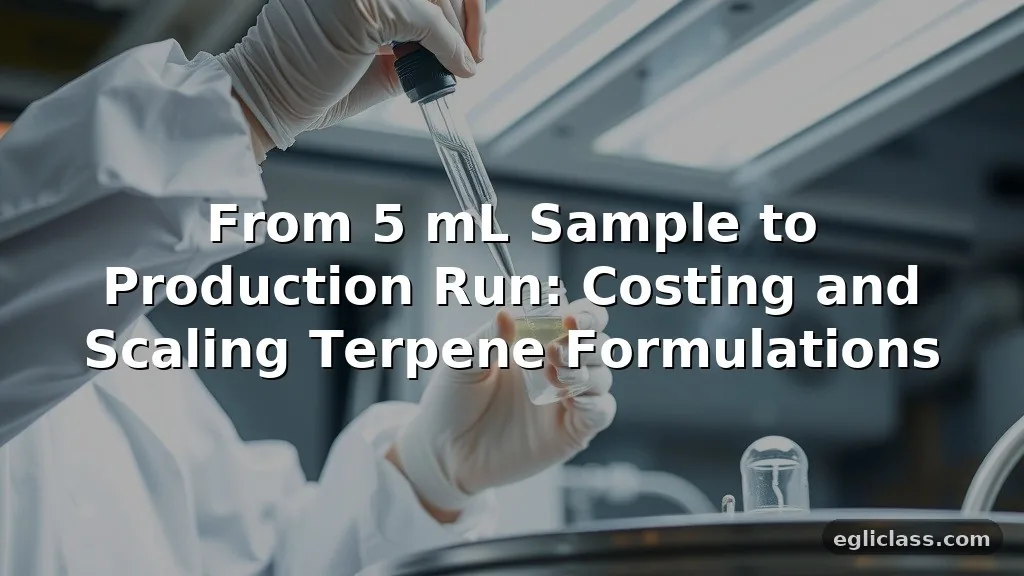
The journey from a 5 mL benchtop sample to a full-scale industrial production run is a critical transition that defines the success of many botanical product lines. When a formulator develops a new aromatic profile, the initial work is often done in a controlled laboratory setting using precise pipettes and small-scale glassware.
However, moving from this delicate, milliliter-based experimentation to manufacturing thousands of liters requires a rigorous shift in methodology, financial planning, and quality control. Scaling terpene formulations is not merely a matter of multiplying the ingredients; it involves understanding the physical properties of volatile compounds, the economics of sourcing, and the logistical challenges of large-scale blending.
Understanding the Fundamentals of Terpene Formulation
Before scaling up, one must master the chemistry behind the formulation. Terpenes are volatile organic compounds responsible for the distinct aromas and flavors found in plants.
In a professional setting, terpene mixing is an exact science that relies on precision. When working with a 5 mL sample, a minor measurement error might be negligible, but when that same error is magnified by a factor of 1,000 in a production batch, it can result in a product that is either overpowered or lacks the intended aromatic profile.
The formulation process begins with identifying the desired flavor profile or therapeutic effect. Most professionals use a mixing calculator to ensure the ratios of individual isolates remain consistent. Whether you are aiming for a citrus-heavy profile dominated by limonene or a woody, grounding scent profile rich in beta-caryophyllene, the concentration of each molecule must be documented in a master recipe.
This recipe serves as the blueprint for every subsequent step. By maintaining a database of these formulations, manufacturers can ensure that their products maintain a consistent sensory experience, which is the cornerstone of brand loyalty in the competitive botanical market.
The Economics of Scaling: Moving from Milliliters to Liters
Costing a formulation for a production run is significantly different from estimating the cost of a small sample. When you are buying terpenes in 5 mL or 10 mL vials, you are paying retail prices that include high overheads for packaging, shipping, and small-batch handling.
Transitioning to production-scale manufacturing allows you to move into bulk procurement, which drastically reduces the cost per unit. However, this transition requires a detailed understanding of total cost of ownership, including storage costs, shelf-life management, and potential waste during the mixing process.
To calculate the cost of a production batch, you must break down the price of every raw ingredient used in the formulation. If a product requires a specific concentration of a rare terpene, you must account for the volatility of the market price for that ingredient. Unlike stable commodities, the price of high-quality botanical isolates can fluctuate based on seasonal harvests and extraction yields.
Creating a robust spreadsheet that tracks the weight, volume, and cost of every single ingredient in your formulation is essential. This math must be performed before you place a large-scale order for raw materials to ensure that your margins remain healthy even if ingredient costs spike during the production cycle.
The Role of Precision in Large-Scale Terpene Mixing
Mixing at scale presents unique physical challenges that are rarely encountered in a 5 mL sample. When you move to a 50-liter or 100-liter drum, the viscosity of the carrier oil and the rate at which terpenes integrate into the base become major factors.
You cannot simply dump ingredients into a vat and expect a uniform mixture. Proper blending requires industrial-grade equipment, such as overhead stirrers or inline homogenizers, to ensure the concentration is uniform throughout the entire volume of the product.
Furthermore, the order of addition matters significantly. Some terpenes are more volatile than others and can evaporate rapidly if exposed to heat or excessive air circulation during the mixing process. By following a standard operating procedure (SOP), you ensure that every batch is produced under identical conditions.
This includes temperature control, mixing duration, and the sequence in which ingredients are added to the vessel. If your formulation calls for a specific percentage of a sensitive terpene, it should ideally be added toward the end of the mixing process to minimize exposure to atmospheric conditions that could lead to oxidation or evaporation.
Managing Volatility and Shelf Life in Production
Terpenes are inherently volatile, meaning they evaporate easily at room temperature. When scaling up, you must consider the storage conditions of your raw materials and the final product.
A 5 mL sample might sit on a lab bench for days without significant degradation, but a 500-liter tank of formulated product is a massive investment that requires careful environmental management. You must ensure that your production facility has climate-controlled storage areas to protect your raw materials from heat and light, both of which are the enemies of terpene stability.
As you move toward mass production, shelf-life testing becomes a mandatory component of your workflow. You need to understand how your formulation behaves over time. Does the flavor profile change after three months?
Do the terpenes cause any degradation to the packaging material? These questions are best answered through accelerated stability testing.
By subjecting samples to higher temperatures and humidity, you can predict how your product will hold up on the shelf. This data is vital for setting accurate expiration dates and for making informed decisions about the types of packaging—such as amber glass or high-density polyethylene—that will best protect your formulation from premature degradation.
Quality Assurance and Analytical Testing
In a commercial environment, consistent quality is non-negotiable. Every production run must be validated through analytical testing to ensure it matches the original 5 mL benchtop sample.
This involves using gas chromatography (GC) or high-performance liquid chromatography (HPLC) to verify the concentration of the terpenes in the final product. These tools allow you to perform a “deep dive” into the chemistry of your batch, confirming that the concentration of every compound aligns with your master recipe.
Quality assurance extends beyond just the chemical analysis. It also involves sensory evaluation. Even if the chemistry looks correct on paper, the human nose is an incredibly sensitive instrument.
Professional sensory panels can detect subtle off-notes or imbalances that machines might miss. Before a batch is cleared for packaging, it should be evaluated by a trained team to ensure that the flavor and aroma are exactly what the customer expects. Establishing these quality gates ensures that your production process is repeatable and that every customer receives a high-quality product, regardless of when it was manufactured.
Sourcing Raw Materials for Industrial Volumes
Scaling your terpene formulations requires a shift in how you source your ingredients. When you are experimenting with 5 mL samples, you might source from a variety of boutique suppliers.
For a production run, however, you need reliable, long-term supply partners who can provide consistent purity levels and batch-specific certificates of analysis (COA). Relying on inconsistent suppliers can lead to massive headaches, as even minor variations in the purity of a raw isolate can alter the entire flavor profile of your final product.
When negotiating with suppliers for bulk quantities, always request a COA for the specific lot you are purchasing. This document provides the chemical breakdown of the isolate, confirming it is free from contaminants like heavy metals, pesticides, or residual solvents. You should treat these COAs as legal documents and maintain a library of them for every batch of raw materials you receive.
This level of diligence is standard practice in the food and pharmaceutical industries, and it is equally necessary when working with terpenes for consumer products. You can find more information on the standards for chemical analysis and quality control through the National Institute of Standards and Technology, which provides authoritative guidance on measurement science.
Calculating Ratios: The Math of Scaling
The math involved in scaling a formulation from a 5 mL sample to a 100-liter batch is a common point of failure for new manufacturers. The primary challenge is converting between units of volume (mL) and weight (grams).
Because different terpenes have different densities, you cannot simply assume that 1 mL of one terpene equals 1 gram. A precise formulation requires you to account for the specific gravity of every ingredient to ensure the ratios remain exact as you scale up.
If your 5 mL sample uses a 2% concentration of a specific terpene, you must calculate exactly how many grams are needed for a 100-liter production run, taking into account the density of the carrier fluid and the terpene itself. A common error is to use volume-based measurements for everything, which leads to significant inaccuracies.
Always use a high-precision digital scale to measure your ingredients by weight during the formulation process. By converting everything to mass, you remove the variability associated with temperature-related volume expansion, ensuring that every batch is mathematically identical to the last.
Equipment Requirements for Scaling Up
The equipment you use for a 5 mL sample is vastly different from what is needed for a production run. While you might use a glass beaker and a magnetic stir bar for your initial development, a production run requires stainless steel mixing vessels, industrial pumps, and filtration systems. The choice of materials is critical; terpenes are powerful solvents and can degrade certain types of plastics or rubber seals over time.
When selecting your equipment, look for food-grade or pharmaceutical-grade stainless steel (usually 316L) that is resistant to corrosion. All seals, gaskets, and hoses must be made of materials that are chemically compatible with terpenes, such as PTFE (Teflon).
Using the wrong materials can lead to contamination of your product, where the terpenes leach chemicals from the equipment itself. Investing in the right infrastructure early in the scaling process saves you from the cost and frustration of replacing damaged equipment and dealing with product recalls due to contamination.
Standard Operating Procedures and Staff Training
A production run is only as good as the people running the equipment. When you move from a solo lab project to a manufacturing environment, you must formalize your processes into written Standard Operating Procedures (SOPs).
These documents should describe every step of the formulation process, from the initial cleaning of the mixing vessel to the final bottling and labeling. An SOP ensures that every member of your team understands exactly how to perform the task, which minimizes the risk of human error.
Training is equally important. Your staff should understand not just how to mix the ingredients, but why the order of addition matters, how to handle the raw materials safely, and what to do if a measurement is off.
Regular training sessions and “refresher” courses help keep safety and quality at the forefront of your operations. When everyone on the floor understands the importance of the concentration ratios and the sensitivity of the ingredients, you create a culture of excellence that reflects in the final product.
Regulatory Compliance and Documentation
As you scale from a small sample to a commercial product, you enter a new world of regulatory scrutiny. Depending on your jurisdiction and the nature of your product, you may need to comply with various health and safety regulations.
This includes labeling requirements, allergen disclosures, and potentially registration with local health authorities. Documentation is your best defense in any regulatory audit.
Every production run should have a batch record—a comprehensive document that tracks the lot numbers of all raw materials, the names of the personnel involved, the specific equipment used, and the results of the final quality testing. If a customer ever has a question or a complaint about a specific batch, you should be able to trace that product back to the exact day it was made, the ingredients that went into it, and the person who signed off on the quality check. This level of traceability is not just a regulatory requirement; it is a mark of a professional, reliable brand that customers can trust.
The Importance of Iteration and Continuous Improvement
Even after you have successfully scaled a formulation, the work is not finished. Consumer preferences change, and new, higher-purity ingredients may become available.
A successful company treats every production run as an opportunity to refine the process. By collecting data on every batch, you can identify trends—such as minor flavor shifts that occur over time or opportunities to optimize your ingredient costs without sacrificing quality.
Continuous improvement also applies to your internal processes. Perhaps you find that a different type of filtration system allows for a faster production cycle without impacting the final aroma. Or maybe you discover that a slight adjustment to the mixing speed improves the homogeneity of the batch.
By maintaining an open dialogue between the lab team and the production floor, you foster an environment of innovation. The transition from a 5 mL sample to a production run is a significant milestone, but it is merely the beginning of a long-term journey toward creating the best possible product for your customers.
Final Considerations for Sustained Growth
When you finally reach the stage where you are producing large batches, your focus should shift toward efficiency and sustainability. Scaling up is not just about producing more; it is about producing more efficiently while maintaining the integrity of the original formulation. This might mean investing in automated filling and capping lines to reduce labor costs, or optimizing your supply chain to reduce the carbon footprint of your raw material shipments.
Every aspect of your production, from the initial mixing to the final shipping, should be viewed through the lens of optimization. When you prioritize consistency and quality, you build a reputation that allows your brand to thrive in a crowded market. Remember that the terpenes you work with are delicate, complex, and powerful.
Treating them with the respect they deserve, through careful math, rigorous testing, and professional-grade equipment, ensures that the vision you first captured in a 5 mL sample is successfully delivered to every customer who opens your product. By focusing on these core pillars of scaling—precision, documentation, and constant refinement—you can successfully transition from the benchtop to the warehouse, ensuring your formulations stand the test of time and market demand.