
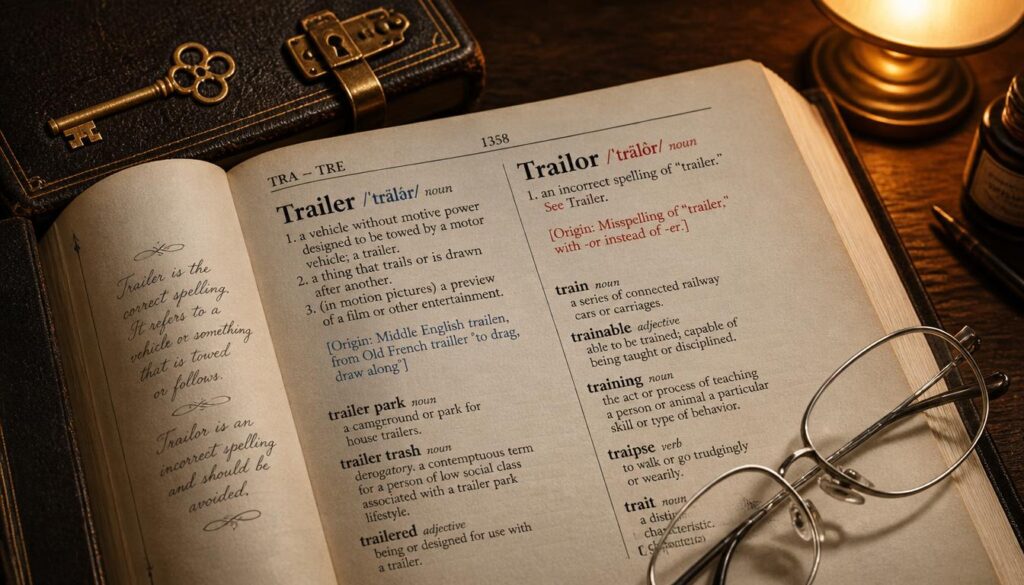
If you’ve ever paused mid-sentence wondering whether to type “trailer” or “trailor,” you’re not alone. This is one of those spelling mix-ups that trips up even confident writers, and it tends to sneak into emails, social captions, and even business documents before anyone notices. The good news is that the fix is simple once you understand where the confusion actually comes from.
Let’s settle this properly: trailer is the only correct spelling. “Trailor” isn’t a word in standard English at all — it’s a common misspelling, not an alternate version. But knowing that is only half the battle. The more useful thing is understanding why so many people get it wrong in the first place, because that’s what actually helps the correct spelling stick.
Why Do People Mix Up Trailer and Trailor?
English has a habit of setting traps for itself, and this is one of them. The confusion isn’t random — it follows a pretty predictable pattern.
The “-or” Suffix Trap
English is full of words that end in -or: actor, inventor, governor, advisor, professor. These are called agent nouns, and they typically describe a person who does something. Because these words are so common, some writers unconsciously assume that any word ending in that “-er/-or” sound should follow the same pattern.
The problem is that trailer was never built the same way. It comes from the verb “trail,” and English nouns formed from verbs almost always take the -er ending — think teacher (from teach), baker (from bake), or player (from play). Trailer belongs firmly in this second group, not the actor/inventor group.
It’s Also a Pronunciation Thing
Say “trailer” and “trailor” out loud. They sound almost identical, especially in fast or casual speech. When a word’s spelling isn’t obvious from how it sounds, people tend to guess — and guesses don’t always land on the historically correct form. This is the same reason people mix up words like “definately” for “definitely” or “recieve” for “receive.” The ear hears one thing; the hand writes another.
Autocorrect and Casual Typing Don’t Help
A lot of the “trailor” spellings floating around online aren’t really spelling mistakes in the traditional sense — they’re typing habits. When you’re firing off a quick text or a social media caption, your brain is moving faster than your fingers, and small errors like this slip through unnoticed. Over time, seeing “trailor” used casually by other people (even if it’s wrong) can make it feel more legitimate than it actually is.
What Does “Trailer” Actually Mean?
Part of what makes this word tricky is that it isn’t just one thing — trailer covers several distinct meanings depending on context. Understanding these different uses actually makes the spelling easier to remember, because you start associating “trailer” with real, everyday situations instead of just memorizing a rule.
1. A Trailer as a Towed Vehicle
This is probably the most common everyday use. A trailer is a wheeled, unpowered vehicle pulled behind a car, truck, or other vehicle, usually to haul cargo, equipment, or even living quarters.
Scenario example:
Subject: Need to Borrow Your Trailer Hi Dan, I’m moving into my new apartment this Saturday and I don’t have anything big enough to haul the couch and dresser. Could I borrow your utility trailer for the day? I’ll fill up the tank before I bring it back. Thanks, Priya
Notice how naturally the word fits here. If Priya had written “trailor” in that email, it wouldn’t change the meaning — but it would make the message look rushed or careless, especially in a request where she’s asking for a favor.
2. A Trailer as a Movie or Show Preview
In entertainment, a trailer is a short promotional clip released ahead of a film, series, or game to build anticipation.
Scenario example:
Subject: New Trailer Just Dropped Hey team, The studio just released the official trailer for the sequel, and it’s already trending. Can we get our reaction post scheduled before the end of the day? Traffic on trailer drops tends to spike within the first few hours. Best, Marcus
This is one of the most searched contexts for the word, and it’s also where the misspelling shows up most often online — probably because entertainment content gets written and posted quickly, with less time for proofreading.
3. A Trailer as a Mobile Home
Historically, trailer also refers to a small, movable dwelling — what most people now call a mobile home. This usage dates back to the early-to-mid 20th century, when compact towable homes became a practical housing option.
Scenario example:
Growing up, my grandparents lived in a trailer just outside a small lake town in Michigan. It wasn’t fancy, but it had everything they needed, and honestly, some of my best childhood memories happened in that little trailer kitchen.
This usage still appears in everyday conversation, real estate listings, and casual storytelling, and the spelling rule doesn’t change no matter which meaning you’re using.
4. Trailer as a Verb
Less commonly, “trailer” can function as a verb, meaning to tow or haul something using a trailer.
Scenario example:
We’re planning to trailer the boat up to the lake this weekend before the weather turns.
Whether it’s a noun or a verb, the spelling stays exactly the same: trailer, not trailor.
The Simple Rule to Remember
Here’s the part worth bookmarking: English nouns derived from verbs almost always end in “-er,” not “-or.”
| Verb | Correct Noun |
|---|---|
| trail | trailer |
| teach | teacher |
| play | player |
| bake | baker |
| write | writer |
Compare that to agent nouns that aren’t built from common English verbs the same way:
| Word | Type |
|---|---|
| actor | Latin-derived agent noun |
| governor | Latin-derived agent noun |
| inventor | Latin-derived agent noun |
Trailer doesn’t belong in that second group at all. It’s a straightforward “-er” noun, just like hundreds of other everyday English words. Once you see the pattern, the spelling stops feeling like something you have to memorize and starts feeling obvious.
Common Trailer vs Trailor Mistakes (And How to Fix Them)
Seeing the wrong version next to the right one is one of the fastest ways to make the correct spelling stick. Here are the mistakes that show up most often:
- Wrong: We need a trailor to haul the equipment to the site. Correct: We need a trailer to haul the equipment to the site.
- Wrong: Did you catch the new trailor for the horror movie? Correct: Did you catch the new trailer for the horror movie?
- Wrong: They spent the summer in a trailor by the coast. Correct: They spent the summer in a trailer by the coast.
- Wrong: She parked the trailor outside the storage unit. Correct: She parked the trailer outside the storage unit.
A quick trick that helps: if you can imagine the word paired with “teacher” or “player” in your head, it reinforces the -er ending. That small mental association does a lot of heavy lifting.
Where “Trailer” Comes From
Words tend to make more sense once you know their history, and trailer is no exception.
- 1580s — The verb “trail” enters English, meaning to drag or pull something behind.
- 1890s — “Trailer” starts being used to describe a vehicle towed behind another.
- 1910s — The film industry adopts “trailer” for promotional previews, originally because they were shown after the main feature (hence “trailing” it), before eventually moving to the front.
- 1920s–1940s — “Trailer” becomes associated with mobile homes as towable living quarters grow in popularity across the U.S.
That last point is actually a fun bit of trivia: movie trailers used to trail the film, not precede it. The name stuck even after the placement changed — which is a good reminder that English spelling and meaning don’t always evolve at the same pace.
Does the Spelling Change Across Countries?
No — and this is worth knowing if you write for an international audience. Whether you’re writing for readers in the United States, United Kingdom, Canada, Australia, or New Zealand, the spelling stays consistent: trailer. Pronunciation shifts slightly from region to region (British English speakers often soften the “r” sound), but the written form never changes. This is different from words like “colour/color” or “organise/organize,” where regional spelling variants genuinely exist. Trailer isn’t one of those words — “trailor” isn’t a British spelling, an Australian spelling, or any accepted regional variant. It’s simply incorrect everywhere.
Why This Small Mistake Actually Matters
It’s easy to shrug off a single misspelled word, but in professional or public-facing writing, small errors add up to a bigger impression. A misspelled word in a job application, a rental agreement, a marketing email, or a client-facing message can quietly signal carelessness, even if the rest of the writing is strong.
Scenario example (professional context):
Subject: Confirming Trailer Rental for Next Week Dear Mr. Alvarez, I’d like to confirm our reservation for a 6×10 utility trailer for next Thursday through Sunday. Please let me know if you need a deposit ahead of pickup. Kind regards, Renee
If Renee had typed “trailor” in a rental confirmation, it likely wouldn’t cause any real misunderstanding — but it might make the reader pause, even briefly, in a way that a clean, correctly spelled message wouldn’t. In professional communication, those small pauses matter more than people think.
Helpful Synonyms Depending on Context
Since “trailer” covers such different meanings, it helps to have some related words on hand — both to avoid repetition and to add precision.
For vehicles: caravan, camper, hauler, utility trailer, travel trailer
For movie/media previews: teaser, preview, promo, sneak peek, clip
Scenario example blending both:
We released a short teaser last week to build hype, and the full trailer goes live Friday alongside our new camper trailer giveaway promotion.
Using varied but accurate vocabulary like this not only reads more naturally — it also shows a stronger command of the language than repeating the same word over and over.
Quick Recap: Trailer vs Trailor
- Correct spelling: trailer
- Incorrect spelling: trailor (not a recognized English word)
- Why the mistake happens: pronunciation confusion, overgeneralizing “-or” agent nouns like actor and inventor, and casual typing habits
- Rule to remember: verb-based English nouns almost always end in “-er,” just like teacher, player, and baker
- Consistent across all English-speaking regions: US, UK, Canada, Australia, and New Zealand
Final Thoughts
At the end of the day, the trailer vs trailor debate isn’t really a debate at all — there’s a clearly correct answer, and it’s trailer, in every context and every region. The mix-up happens for understandable reasons: English pronunciation doesn’t always match spelling, and our brains like to apply familiar patterns even when they don’t fit. Once you connect trailer to its true verb-based family (trail → trailer, just like teach → teacher), the correct spelling becomes second nature.
Whether you’re writing about a towed vehicle, a movie preview, a mobile home, or using it as a verb, the rule never changes. Get comfortable with that one detail, and you’ll never have to second-guess yourself the next time you sit down to write.