
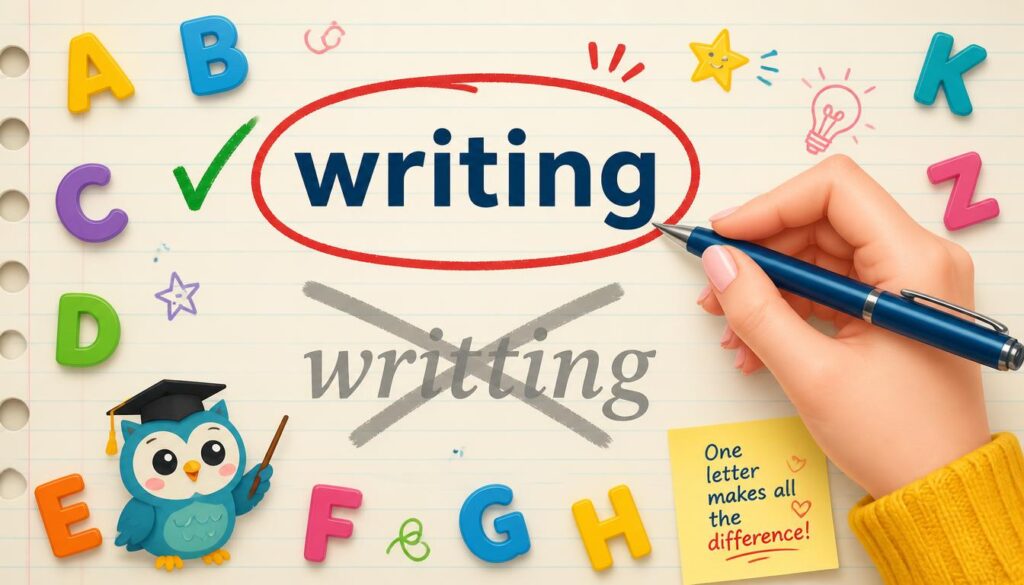
You’re halfway through an email, your fingers are moving faster than your brain, and suddenly there it is on the screen: writting. You pause. It looks… off. But is it actually wrong, or is your brain just playing tricks on you after staring at the same word too long?
Here’s the short answer: writting is not a word. It never has been, and it never will be, no matter how many times you see it typed out in a rushed text message or a comment section. The correct spelling, in every single context, is writing.
But knowing that isn’t quite the same as understanding why — and understanding why is what actually makes the mistake disappear for good. So let’s dig into the grammar, the logic, and a handful of real-world scenarios that show exactly where this mix-up tends to happen.
Writing vs Writting: Which One Is Actually Correct?
Let’s settle this immediately, because there’s no ambiguity here: writing is correct. Writting is a spelling error, full stop. It doesn’t appear in any dictionary, it isn’t a regional variant, and it isn’t an acceptable alternative in any style guide — not APA, not MLA, not Chicago, nothing.
So why does this particular typo show up so often? It mostly comes down to a collision between two spelling rules that look similar but don’t actually apply the same way. English is full of these little traps, and this is one of the more common ones.
The Two Rules That Cause the Confusion
There are two spelling patterns fighting for control here:
- The silent e rule: When a verb ends in a silent e (like write, hope, or bake), you drop the e before adding -ing. So write becomes writing, not writeing.
- The consonant doubling rule: When a short verb ends in a single vowel followed by a single consonant, and the stress falls on that last syllable, you double the consonant before adding -ing. That’s why run becomes running and sit becomes sitting.
The problem is that write sits right at the intersection of these two rules, and a lot of people’s brains default to the doubling pattern because it’s so common in short, punchy verbs. But write doesn’t meet the conditions for doubling — it ends in a silent e, not a bare consonant — so the silent e rule wins. Drop the e, add -ing, and you’re left with writing.
Why “Writting” Feels Right (Even Though It Isn’t)
This is the part most articles skip, and it’s honestly the more interesting question. Nobody types writting because they don’t know how to spell — they type it because the mistake makes a strange kind of sense.
Think about how many common verbs follow the doubling pattern:
- sit → sitting
- run → running
- swim → swimming
- plan → planning
Your brain builds a pattern from repetition, and write just happens to sound like it belongs in that group. Add to that the fact that the t sound in “writing” is crisp and clearly pronounced, and it’s easy to see why some part of your brain insists there should be two of them.
There’s also the simple mechanical explanation: typing speed. When you’re moving quickly, your fingers sometimes double-tap a key out of habit, especially one that’s already muscle memory from words like sitting or getting.
None of this makes writting correct. But it does explain why even careful writers slip up occasionally.
Scenario Examples: Writing vs Writting in Real Life
Grammar rules are one thing, but seeing the words in actual context makes the correct choice stick a lot better. Here are a few everyday situations where this mistake tends to sneak in — and how to fix it.
Scenario 1: The Business Email
Imagine you’re writing a professional email to a client. You’ve spent ten minutes getting the tone just right, and then this happens:
❌ “I am writting to follow up on our conversation from last week.”
✅ “I am writing to follow up on our conversation from last week.”
That single extra letter can undercut an otherwise polished message. In professional communication, small spelling errors have an outsized effect — they make readers question your attention to detail, even if the rest of the email is flawless.
Scenario 2: The Academic Paper
A student drafting a thesis statement types:
❌ “This paper focuses on the author’s writting style throughout the novel.”
✅ “This paper focuses on the author’s writing style throughout the novel.”
In academic settings, spelling errors like this one tend to stand out even more, since the surrounding language is often formal and precise. A single typo can pull a reader’s focus away from the actual argument.
Scenario 3: The Casual Text Message
Even informal writing benefits from getting this right:
Maya: what are you up to tonight? Jordan: just writing in my journal, nothing exciting
Here, writing fits naturally into a relaxed, conversational tone. If Jordan had typed writting, it would have looked like a typo mid-sentence — small, but noticeable enough to make a reader pause.
Scenario 4: The Job Application
A cover letter is one place where spelling really can’t afford to slip:
❌ “I have five years of experience writting marketing copy for e-commerce brands.”
✅ “I have five years of experience writing marketing copy for e-commerce brands.”
Hiring managers often skim cover letters quickly, and a spelling mistake in a sentence about your own writing experience is the kind of irony that’s hard to recover from.
Breaking Down the Verb “Write” in All Its Forms
Part of what makes this mistake so persistent is that write doesn’t behave the same way in every tense. Here’s a quick reference table to keep the forms straight.
| Form | Example |
|---|---|
| Base form | I want to write a novel someday. |
| Past tense | She wrote a letter to her grandmother. |
| Past participle | The report was written by the entire team. |
| Present participle | He is writing his dissertation this semester. |
Notice something interesting: written does have a double t, but writing does not. That’s not inconsistency — it’s because past participles and present participles are formed through entirely separate patterns in irregular verbs like write. The past participle written is simply an irregular form, similar to how eat becomes eaten rather than eated.
Writing vs Written: A Quick Clarification
Since we’re already comparing forms, it’s worth separating out another common point of confusion:
- Writing is the present participle, used for ongoing or continuous action. “I am writing a report right now.”
- Written is the past participle, used for completed action, usually with “has,” “have,” “was,” or “were.” “The report has already been written.”
These two words serve completely different grammatical roles, so mixing them up changes the meaning of a sentence, not just its spelling.
A Simple Trick to Lock This In
If you want a memory device that actually sticks, try this one:
“Drop the e, don’t double the t.”
Say it out loud a couple of times. It’s short, it rhymes just enough to be memorable, and it directly addresses both rules that cause the confusion in the first place. The next time your fingers start typing writt-, that little phrase should be enough to make you pause and correct course.
Other Practical Fixes
A few habits can help beyond just memorization:
- Slow down on double letters. If a word has back-to-back consonants, give it a second glance before hitting send.
- Trust your spell checker, but don’t rely on it blindly. Autocorrect catches most instances of writting, but it won’t catch every context, especially in fast typing on mobile keyboards.
- Read your sentence back once. This is especially useful in professional or academic writing, where a fresh read often reveals errors your brain skipped over the first time.
Why This Small Mistake Matters More Than It Seems
It’s easy to dismiss a single misspelled word as trivial, especially in casual conversation. But there’s a reason spelling still matters, even in an age of quick texts and auto-correcting keyboards.
Credibility is built in small moments. A resume, a cover letter, a client email, an academic paper — these are all situations where the reader is forming an impression of you based on details you might not even notice you’re providing. A spelling mistake doesn’t necessarily mean someone is careless or unintelligent, but it can create that impression in a reader’s mind, fairly or not.
This is especially true for English language learners, who often get unfairly judged more harshly for small errors than native speakers do. Getting a common mix-up like writing vs writting locked in early removes one small but real obstacle in professional and academic communication.
Frequently Asked Questions
Is “writting” ever correct in any dialect of English?
No. Whether you’re writing in American English, British English, Australian English, or any other standard variety, writting is not a recognized word. There are no regional exceptions here.
Why does “written” have a double t if “writing” doesn’t?
Because they’re formed differently. Writing follows the silent e dropping rule (write → writing). Written is simply an irregular past participle, similar to how bite becomes bitten rather than biting in that tense. English has plenty of irregular verbs that don’t follow a single consistent pattern across all their forms.
What’s an easy way to remember the correct spelling?
Use the phrase “drop the e, don’t double the t.” It directly reminds you of both rules at play and takes just a second to recall.
Does autocorrect always catch this mistake?
Usually, yes — but not always, especially on mobile devices where predictive text sometimes autocompletes based on your typing patterns rather than correcting outright errors. It’s worth proofreading important messages rather than trusting autocorrect completely.
Final Thoughts
Spelling rules in English rarely feel intuitive, and write is a perfect example of a word that seems like it should follow one pattern but actually follows another. The good news is that once you understand why writing is correct — silent e dropped, no doubled consonant — the rule becomes easy to apply consistently, whether you’re writing a quick text, a formal email, or a full research paper.
So the next time your fingers start to type that extra t, remember the simple fix: drop the e, skip the double letter, and you’ll land on writing every single time.