
You’re typing a quick reply to your boss. She’s asked if you can join tomorrow’s meeting, and you want to sound both professional and warm. Your fingers move fast: “Of course, I’ll be there.” Then you pause. Wait — is it of course, or is it ofcourse? Should it even have a space?
If you’ve ever hesitated over this exact question, you’re far from alone. It’s one of those small spelling snags that trips up even confident writers, mostly because the phrase sounds like a single word when we say it out loud. But English spelling doesn’t always follow the sound of speech, and this is a perfect example of that gap.
Let’s settle this once and for all — with real explanations, real examples, and a few detours into why this mistake happens so often in the first place.
The Short Answer: Of Course Is Correct
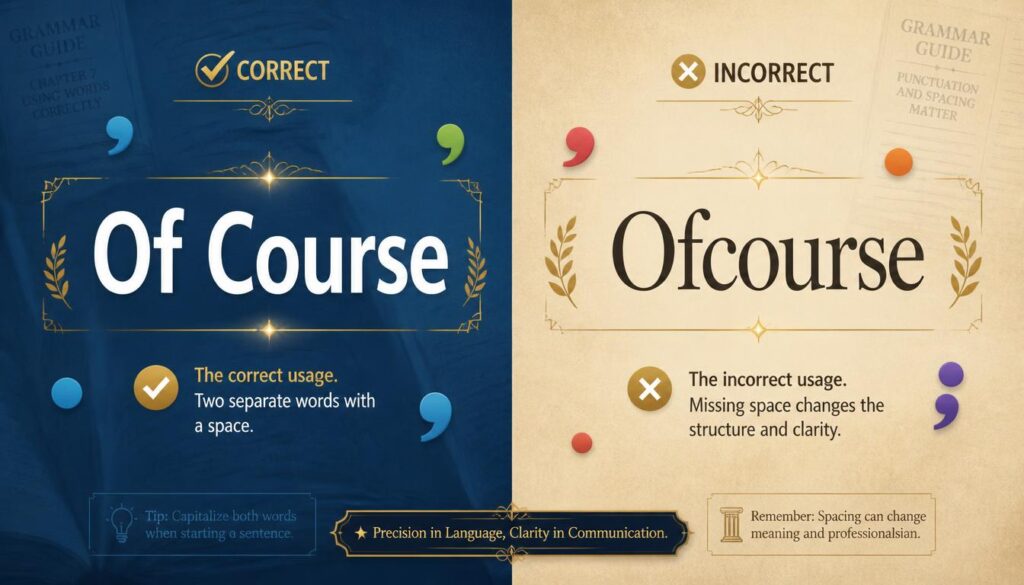
There’s no ambiguity here. “Of course” — written as two separate words — is the only correct form. “Ofcourse” is not a word. You won’t find it in Merriam-Webster, the Oxford English Dictionary, Cambridge Dictionary, or any other reputable English reference. It’s simply a misspelling that has become common because of how the phrase sounds when spoken quickly.
Here’s the breakdown:
- Of is a preposition.
- Course is a noun.
- Together, “of course” forms an idiomatic phrase meaning certainly, naturally, or as expected.
Prepositions and nouns don’t fuse into single words in English just because we say them fast. Think about phrases like “in fact,” “at least,” or “by chance” — nobody writes those as “infact,” “atleast,” or “bychance” (well, some people try, and they’re wrong too).
Why Do So Many People Write “Ofcourse”?
This is the interesting part, honestly. The mistake isn’t random — there’s a pattern behind it, and understanding that pattern makes it much easier to avoid.
Pronunciation Blends the Words Together
When you say “of course” out loud, your mouth naturally glides from one word into the next. The “f” sound in “of” connects smoothly to the “c” in “course,” and the result sounds like a single unit: uhv-kors. Since spelling is supposed to represent sound, it’s an understandable leap to assume it’s written as one word too.
English Already Has Plenty of Compound Words
We write “notebook,” “website,” “haircut,” and “bookstore” as single words, so it’s not unreasonable for someone to guess that “of course” might follow the same rule. The problem is that compound words usually form from two nouns or a noun and a verb — not from a preposition plus a noun functioning as an idiom. “Of course” simply never went through that transformation.
Autocorrect and Text Speed
In fast typing environments — texting, Slack, WhatsApp — people often don’t pause to check spelling. If “ofcourse” gets typed once and autocorrect doesn’t flag it (which, on many keyboards, it won’t, since it can be misread as a rushed compound), the habit sticks.
Of Course vs. Off Course: Don’t Mix These Up
Here’s where things get genuinely confusing, because there’s a second phrase lurking nearby that sounds almost identical: “off course.”
These two phrases are not interchangeable, and they don’t mean the same thing at all.
| Phrase | Meaning | Example |
|---|---|---|
| Of course | Certainly, naturally, obviously | “Of course, I’ll help you move this weekend.” |
| Off course | Not on the intended path or route | “The plane drifted off course during the storm.” |
Scenario Example: Imagine a sailor radioing back to shore. If she says, “We’re off course,” she means the ship has strayed from its planned route — maybe due to wind or a navigation error. If she instead says, “Of course we’ll make it back by nightfall,” she’s expressing confidence, not location. Same sounds, completely different meanings.
And just to close the loop: “offcourse,” written as one word, is wrong in both cases. It’s not a real spelling of either phrase.
What Does “Of Course” Actually Mean?
“Of course” is used to express certainty, agreement, or obviousness. It’s one of those flexible little phrases that shows up constantly in everyday English because it does several jobs at once.
It Signals Something Is Obvious
“Of course the store is closed — it’s a holiday.”
It Grants Polite Permission
“Can I borrow your charger?” “Of course, go ahead.”
It Expresses Strong Affirmation
“Are you still coming to the wedding?” “Of course!”
It Softens a Response
Adding “of course” to a sentence often makes it sound warmer and more accommodating, rather than blunt. Compare “I’ll send the report” with “Of course, I’ll send the report” — the second one reads as more considerate.
Scenario Examples: Seeing “Of Course” in Real Situations
Reading a definition is one thing. Seeing how a phrase actually behaves in context is what makes it stick. Here are a few realistic scenarios.
Scenario 1: A Formal Work Email
Subject: Re: Quarterly Report Review
Hi Daniel,
Thanks for reaching out. Of course, I’d be happy to go through the numbers before Thursday’s meeting. Could you send the spreadsheet by tomorrow morning so I have enough time to review it properly?
Best, Melissa
Notice how “of course” here signals willingness, not just agreement. It tells Daniel that Melissa isn’t just tolerating the request — she’s happy to help.
Scenario 2: Customer Service Reply
Subject: Address Change Request
Dear Mr. Green,
Thank you for letting us know. Of course, we can update your shipping address right away. Please allow up to 24 hours for the change to take effect in our system.
Kind regards, Emily Customer Support Team
In this context, “of course” reassures the customer that the request is simple and expected — nothing unusual or inconvenient.
Scenario 3: A Text Message Between Friends
Alex: Hey, you still coming to the game night? Jordan: Of course! Wouldn’t miss it for anything.
Casual, quick, and confident — this is “of course” doing what it does best in everyday conversation.
Scenario 4: A Misused Version (What Not to Do)
Compare that to this real-world mistake, pulled from the kind of message people send without thinking twice:
“Ofcourse I’ll be there, no worries!”
It reads fine to a casual eye, but in a professional context — a client email, a cover letter, a formal report — this small error can chip away at credibility. It suggests carelessness, even if the writer clearly knows the language well otherwise.
How to Get It Right Every Time
If you want a foolproof way to remember this, try this trick: replace “of course” with “certainly” in your head before you write it. If “certainly” fits the sentence, then “of course” (two words) is what you need. You’d never write “certainly” as “certain-ly” squished together, and the same logic applies here.
Quick Rules to Remember
- ✅ “Of course” — always two words, always correct.
- ❌ “Ofcourse” — never correct, not a recognized word.
- ✅ “Off course” — correct, but means something entirely different (off the intended path).
- ❌ “Offcourse” — also incorrect, regardless of context.
Do’s and Don’ts
Do:
- Use “of course” in both formal and casual writing.
- Capitalize it when it starts a sentence: “Of course, that works for me.”
- Use it to soften requests or responses and make them sound more polite.
Don’t:
- Write “ofcourse” in emails, essays, reports, or any official communication.
- Confuse it with “off course,” which refers to direction, not agreement.
- Assume spellcheck will always catch it — some tools miss this one.
A Quick Detour Into History
Here’s a fact that tends to surprise people: “of course” originally comes from sailing. In nautical language, a ship’s “course” referred to its planned route, and something happening “of course” meant it was happening along or in line with that expected path — essentially, “as planned” or “naturally following the route.”
Over the centuries, that literal, navigational meaning drifted (pun intended) into the more abstract sense we use today: something obvious, expected, or granted without hesitation. It’s a nice reminder that a lot of everyday English carries little fragments of much older, more specific meanings — you just don’t notice them anymore.
Why This Small Mistake Actually Matters
It might seem like a trivial thing — one letter’s worth of spacing, barely noticeable in a fast-moving conversation. But in professional writing, small inconsistencies like “ofcourse” can quietly undermine how careful and competent you appear.
Think about it from the reader’s side. A single typo rarely ruins someone’s impression of you. But when the same kind of error — treating multi-word phrases as compound words — shows up repeatedly across emails, reports, or client messages, it starts to read as a pattern rather than a slip. And patterns are what people remember.
This matters more in some settings than others.
Formal Writing
In business emails, academic papers, legal documents, or any communication representing a company or institution, precision counts. “Of course, we’ll have the deliverables ready by Friday” reads as clean and professional. “Ofcourse we’ll have the deliverables ready” reads as rushed, even careless.
Informal Writing
In texts or casual chats with friends, nobody’s going to call you out for writing “ofcourse.” Language is more forgiving there. Still, building the habit of spelling it correctly means you won’t accidentally carry the mistake into a context where it does matter — like a job application or a client-facing message.
Words You Can Use Instead
If you’re writing something longer and want to avoid repeating “of course” over and over, English gives you plenty of alternatives that carry a similar sense of certainty or agreement:
- Certainly
- Absolutely
- Definitely
- Without a doubt
- Naturally
- Sure
Example swap: Instead of “Of course, I’ll take care of it,” you could write “Absolutely, I’ll take care of it” or “Certainly, I’ll handle that.” Rotating your word choice keeps writing from sounding repetitive, especially in longer emails or articles where the phrase might otherwise appear several times.
Common Mistakes and How to Fix Them
| Mistake | Why It’s Wrong | Correct Version |
|---|---|---|
| “Ofcourse I agree.” | Not a recognized word in English | “Of course I agree.” |
| “Offcourse you can join us.” | Misspelling with mismatched meaning | “Of course you can join us.” |
| “We went offcourse on the trip.” | Should reflect direction, not agreement | “We went off course on the trip.” |
Final Thoughts
So, back to the original question: is it “of course” or “ofcourse”? The answer hasn’t changed, and it never will — “of course” is correct, written as two separate words, every single time. “Ofcourse” is a misspelling, and “off course” is a completely different phrase about direction, not certainty.
It’s a small detail, but small details add up. The next time you’re drafting an email, replying to a friend, or writing something more formal, take that extra half-second to double-check the spacing. Your writing will look sharper for it — and honestly, once you’ve thought it through this clearly, you probably won’t get it wrong again.
Key Takeaways
- Correct spelling: of course (two words)
- Incorrect spelling: ofcourse (not a real word)
- Different phrase entirely: off course (means off the intended path)
- Meaning: an expression of certainty, agreement, or polite affirmation
- Alternatives: certainly, absolutely, definitely, naturally, without a doubt