
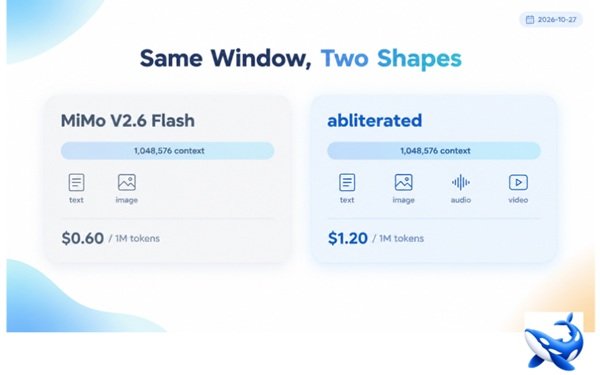
Through OrcaRouter the Xiaomi MiMo V2.6 Flash uncensored build and the Xiaomi base model sit on one key, and the comparison is unusually clean: identical context windows, identical output ceilings, and exactly two differences that matter. Four input modalities against two, and a price that is 5.71× higher on both sides [OURS].
Everything else — the window size, the ceiling, the tokenizer lineage — is the same. That makes the decision a short one.
The comparison
| Xiaomi MiMo V2.6 Flash | OrcaCyber MiMo Flash | |
| Input modalities | text, image | text, image, audio, video |
| Context | 1,048,576 | 1,048,576 |
| Output ceiling | 131,072 | 131,072 |
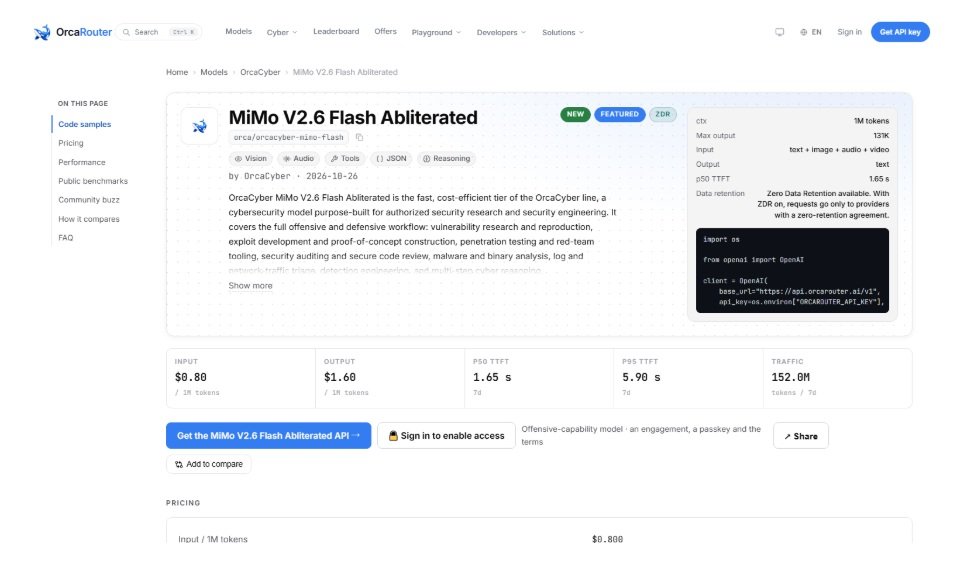
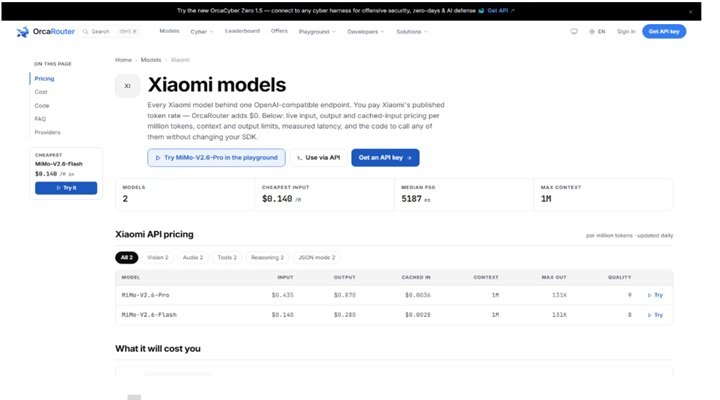
| Input / M | $0.14 | $0.80 |
| Output / M | $0.28 | $1.60 |
| Cache read / M | $0.0028 | $0.15 |
| Refusals | standard | removed |
Two rows are identical, one row is a capability expansion, and the last two are the price of it.
The modality decision is binary
This is not a case where the tuned card is a bit better. It is a case where the base card cannot do a class of work at all.
If any part of your evidence arrives as audio or video, the base model is not a cheaper option — it is not an option. Transcribing first is possible, and it is a different pipeline with a lossy step in the middle.
If none of your evidence does, the audio and video paths are dead weight and the base card is five point seven times cheaper for the same output.
There is no gradual middle. That is worth stating because multimodal capability is often described as if it were a quality axis rather than a set membership.
The price is not only the headline
The cache line deserves its own paragraph, as it does in every comparison involving these two cards. Reads cost $0.0028 on the base and $0.15 on the tuned build — a 53.6× gap [OURS].
A workload that repeats a large prefix — which is most agent architectures — will feel that more than the headline multiple. At a ninety percent hit rate on a million-token prefix, the effective input cost is $0.0165 on the base and $0.215 on the tuned card: a 13× difference.
So the honest multiple for a cache-heavy pipeline is thirteen, not five point seven.
What the base is actually good at
Three things, and they are the reason to keep it rather than replace it.
Volume work. Classification, extraction, first-pass triage at $0.14 input is a different economic regime.
Text and screenshot intake. The common case, and it needs nothing the tuned card adds.
Benchmarking the tuning. Running the same prompts against both is how you demonstrate what the abliteration bought, and it is cheap to do.
A pipeline that uses the base for volume and the tuned card for the refusal-sensitive slice is usually the right architecture, and the shared key makes it a config change.
What the tuned card adds beyond refusal removal
Two things besides the tuning, and they are easy to overlook.
Audio and video as first-class inputs, not as pre-processing steps. That changes the pipeline’s shape, not just its capability list.
A security-oriented post-train. The vendor’s four benchmark rows describe work aimed at security tasks [VENDOR]. The base has no comparable public rows in our catalogue.
Whether that post-train is worth the price depends on whether your workloads look like the vendor’s — which is a question only your own evaluation answers.
When to run both
A simple split that works: base for everything, tuned for the requests the base declines plus anything carrying media.
The rule is expressible in a few lines: if the request has audio or video, route to the tuned card; if the base refuses, retry on the tuned card; otherwise stay on the base.
That pattern gets the cheaper rate for most traffic and the capability where it is needed, and the cost is one fallback branch.
The transition path
If you are already on the base model and moving some traffic, three steps in order.
Instrument both. The same prompt, both cards, for a week. The delta is what you are buying, and it is measured rather than assumed.
Move the media traffic first. It is the case where the base cannot compete at all, so the decision is already made and the move is a pure gain.
Then move the refusals. Start with the requests the base declined, because those are the ones with a measurable cost today.
What you should not do is move everything at once. The 5.71× rate applies to all of it, and the justification only covers part of it.
The numbers to compare, not the ones on the page
When the transition report goes out, three figures belong in it and none of them is a benchmark score.
Refusals removed per thousand requests. Measured, not estimated.
Media requests that previously could not run. A count, which for most teams is the larger number.
Cost delta per month. In currency, at current volume, with the cache assumption stated.
Those three answer the only question a budget holder asks: what changed, and what did it cost. The benchmark rows explain why the vendor built it; these explain why you bought it.
The takeaway
Identical windows, identical ceilings, two extra modalities and a five point seven one times price — which becomes thirteen times on a cache-heavy loop. The decision is about whether audio and video are in your intake.
If they are, there is no cheaper alternative. If they are not, there is no reason to pay.
The one thing the comparison cannot tell you is whether the tuning’s strength was chosen well — whether refusals stop at the point where coherence still holds. That is a judgement about a build, not a price, and the only test is a long output of your own, read end to end.
A final practical note on the comparison: the base card’s measured latency is 3,500 ms to first token against the tuned build’s 1,829 ms [OURS]. That does not mean the tuned build is better hardware — it means the two deployments behave differently, and a pipeline swapping between them should not assume the timeouts carry over.
The comparison closes with a question worth asking out loud: what would have to be true for you to pay three times more per solved task? If the answer is “nothing”, the base card is the right choice and this one is a specialist. If the answer names a specific class of request, you have found the routing rule.
Sourcing note: modalities, context windows, output ceilings and prices for both cards are OrcaRouter catalogue data, checked 2026-10-27 [OURS]. Cache and modality comparisons are arithmetic on those rates. Benchmark rows referenced are the vendor’s own, evaluated 2026-09-20, and are not independently reproduced [VENDOR].