
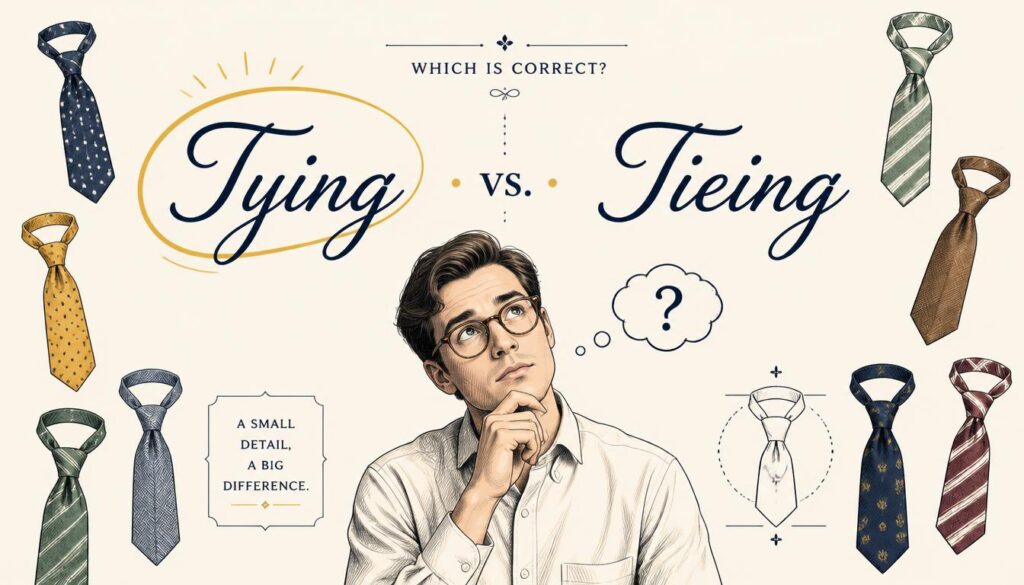
Have you ever typed out a sentence, paused at a word like tieing, and thought — wait, does that look right? You’re not imagining things. This is one of those small spelling snags that trips up native English speakers just as often as learners, and honestly, it makes sense why. The word tie breaks one of the first spelling patterns most of us are taught in school, so when it comes time to add “-ing,” the usual rule seems to fall apart.
Here’s the short version before we dig in: tying is correct. Tieing is not. But the reason why is more interesting than a simple yes-or-no answer, and once you understand it, you’ll never second-guess yourself again — not just with “tie,” but with a whole family of similar words.
Quick Answer: Is It Tying or Tieing?
Let’s settle this right away so you’re not left hanging.
Tying is the only accepted spelling in modern English. You’ll find it in every major dictionary, style guide, and grammar resource. Tieing, on the other hand, isn’t recognized as standard spelling — it shows up occasionally in casual writing or old texts, but it’s considered a mistake by virtually every modern authority on English usage.
So if you’re drafting an email, writing a story, or just texting a friend about tying your shoelaces, go with tying. It’s the version spellcheckers accept, the version teachers expect, and the version that simply looks correct to anyone reading it.
Why “Tying” Is Correct — The Rule Behind It
This isn’t just a random exception. English has a genuine spelling rule that explains exactly why “tie” behaves the way it does.
The “-ie” to “-y” Rule
Most verbs form their present participle by simply adding “-ing” to the base word — walk becomes walking, jump becomes jumping, no changes needed. But verbs that end in “-ie” follow a different path. When you add “-ing” to one of these words, you first swap the “-ie” for a “-y,” and then attach “-ing.”
That gives you:
- tie → tying
- die → dying
- lie → lying
- vie → vying
- untie → untying
- belie → belying
Notice the pattern? None of them keep the “ie.” If they did, you’d end up with clunky, hard-to-read combinations like “tieing,” “dieing,” or “lieing” — words that look wrong because, well, they are.
Why English Bothers With This Rule at All
It comes down to readability. Two vowels sitting right next to a “-ing” ending creates a messy visual cluster that’s awkward to scan and slightly odd to pronounce. Swapping “-ie” for “-y” smooths that out. It’s a small tweak, but it keeps the written word clean and keeps pronunciation intuitive — which, honestly, is what most English spelling rules are quietly trying to do, even when they don’t always succeed.
Is “Tieing” Ever Acceptable?
Here’s where things get a little nuanced. Tieing does show up occasionally — you might spot it in older texts, in some niche hobbyist writing (like certain fly-fishing communities discussing “tieing flies”), or in casual, unedited online posts. But even in those specific communities, most modern writers have shifted to tying flies as the accepted form.
Bottom line: if you’re writing anything that other people will read — a work email, a blog post, a school paper, a resume — stick with tying. Using “tieing” won’t just look unusual; it can come across as a careless mistake, which isn’t the impression you want to leave.
Scenario Examples: Tying in Real Life
Rules are easier to remember when you see them in action. Here’s how tying shows up across different everyday situations.
In a Work Email
Subject: Wrapping Up the Quarterly Report
Hi Daniyal,
I’m just tying up a few loose ends on the report before I send it over. You should have the final version in your inbox by end of day.
Best, Sara
In a Casual Text Message
“Running a bit late — I’m literally tying my shoelaces right now, be there in 5!”
In a Social Media Caption
“Best day of my life. Officially tying the knot with my favorite person today. 💍✨ #JustMarried”
In a Story or Creative Writing
The old sailor knelt on the weathered dock, calloused fingers tying a bowline knot with the kind of ease that only comes from forty years at sea.
See how naturally “tying” fits into every one of these? That’s the giveaway — correct spellings tend to feel invisible. You read right past them. “Tieing” would have snagged your attention in every single example above, and not in a good way.
Other Commonly Confused Word Pairs (And How to Get Them Right)
Since “tying vs. tieing” is really about a broader spelling pattern, it’s worth looking at a few other word pairs that trip people up for similar reasons — either because of the “-ie” rule, or because they just sound alike and get swapped by mistake.
Dying vs. Dieing
Just like “tie,” the verb die follows the same “-ie” to “-y” transformation.
- ✅ Correct: The plant is dying because it hasn’t been watered in weeks.
- ❌ Incorrect: The plant is dieing because it hasn’t been watered.
Scenario example: A nurse charting patient notes would write, “The battery on the monitor is dying and needs to be replaced,” not “dieing” — a mistake that would look unprofessional in a medical record.
Lying vs. Lieing
The verb lie (both “to recline” and “to tell an untruth”) also follows this rule.
- ✅ Correct: She’s been lying on the couch all afternoon watching movies.
- ✅ Correct: He got caught lying about where he’d been.
- ❌ Incorrect: She’s been lieing on the couch.
Scenario example: In a courtroom transcript, an attorney might say, “The witness was lying under oath” — never “lieing,” which would be flagged as an error in any formal legal document.
Vying vs. Vieing
Less common in everyday speech, but it shows up often in news writing.
- ✅ Correct: Three candidates are vying for the same position.
- ❌ Incorrect: Three candidates are vieing for the same position.
Scenario example: A headline might read: “Five Companies Are Vying for the Government Contract” — clean, correct, and exactly what a copy editor would expect to see.
Bonus Mix-Up: “Tying” vs. “Tie-In”
Worth a quick mention since people sometimes blend these two. Tying is the verb form (an action happening now), while tie-in is a noun or adjective referring to something connected or linked to something else — like a “movie tie-in” promotion.
- ✅ Correct: The store is tying balloons to every checkout counter.
- ✅ Correct: The new cereal box is a tie-in with the summer blockbuster movie.
Mixing these up won’t break a spelling rule exactly, but it will confuse your reader about what you actually mean — which is just as important to avoid.
Common Mistakes and How to Fix Them
Here’s a quick-reference table for the mistakes people make most often with “tie” and its relatives.
| Mistake | Why It’s Wrong | Correct Form |
|---|---|---|
| tieing my shoelaces | Breaks the “-ie” to “-y” rule | tying my shoelaces |
| tieing up loose ends | Same issue | tying up loose ends |
| dieing of laughter | Same issue, different base word | dying of laughter |
| lieing about the details | Same issue | lying about the details |
| vieing for attention | Same issue | vying for attention |
Notice a theme? Every single mistake here comes from forgetting to drop the “-ie” and swap in a “-y.” Once that clicks, you’ll catch yourself before the error even reaches the page.
A Simple Memory Trick
If you want a mnemonic that sticks, try this one:
“When you tie, say goodbye to ‘ie’ and say hi to ‘y.'”
It’s a little silly, sure, but that’s exactly why it works — the sillier the phrase, the easier it is to recall under pressure, like when you’re mid-sentence and your brain suddenly blanks on which spelling looks right.
Another trick: picture the word “tying” as already containing the word “tyin'” — casual, contracted, familiar. It just reads right in a way “tieing” never quite does.
Why This Kind of Spelling Confusion Happens So Often
It’s worth pausing on why mix-ups like this are so common, because it’s not really about carelessness. English spelling is famously inconsistent — we learn “add -ing to the base word” as a blanket rule early on, and then spend years discovering the exceptions one at a time. Words ending in “-ie” are a small but stubborn category, and because they don’t come up as often as regular verbs, the exception doesn’t get reinforced the same way.
Add to that the fact that spellcheck tools don’t always catch these errors consistently — some flag “tieing” instantly, while older or more relaxed spellcheckers let it slide, especially in casual writing platforms. That inconsistency is part of why the confusion persists even among people who write for a living.
Synonyms Worth Knowing (For Variety in Writing)
If you find yourself using “tying” repeatedly in a piece of writing and want to mix things up, here are some solid alternatives depending on context:
- Binding — often used for something more formal or restrictive
- Fastening — common in instructional or technical writing
- Securing — good for safety-related contexts (securing cargo, securing a rope)
- Knotting — specific to rope, string, or fabric
- Lacing — typically used for shoes or corsets
- Attaching — broader, used for connecting objects generally
- Tethering — often used for animals, boats, or figuratively (like tethering a device)
Using a mix of these instead of repeating “tying” over and over can make your writing feel more polished and less repetitive — a small trick that professional editors use constantly.
Frequently Asked Questions About Tying and Tieing
Is “tieing” a word in the dictionary?
No. You won’t find tieing listed as a standard entry in major dictionaries like Merriam-Webster, Oxford, or Cambridge. Some dictionaries mention it briefly as a rare or nonstandard variant, but none of them recommend it as correct usage. If you’re writing anything that needs to look polished — a cover letter, a report, a published article — treat “tieing” as a spelling error, not an alternate spelling.
Why does spellcheck sometimes miss “tieing”?
This trips a lot of people up. Not every spellchecker is built the same way, and some older or more lenient tools recognize “tieing” as a loose variant rather than flagging it outright. That inconsistency is part of the reason this mistake slips through even in professional writing. The safest approach is to memorize the rule rather than rely entirely on autocorrect to catch it for you.
Does the same rule apply to British and American English?
Yes. This isn’t a regional spelling difference like “color” versus “colour” or “organize” versus “organise.” Both British and American English follow the same “-ie” to “-y” transformation, so tying is correct on both sides of the Atlantic, and “tieing” is considered incorrect in both varieties as well.
What about words like “eyeing” or “shoeing” — don’t they keep their extra letters?
Good catch, because this is where a lot of confusion creeps in. Words like eyeing and shoeing end in a single “e” (not “ie”), so a different rule applies — one that often keeps the “e” to avoid confusion with another word or to preserve clarity (compare “eyeing” with the unrelated word “eying,” which looks incomplete). The “-ie” to “-y” rule specifically targets verbs that end in the two-letter combination “ie,” like tie, die, lie, and vie — not words ending in a single “e.”
Is there an easy way to test myself on this rule?
Try writing out five sentences using “tying,” “dying,” “lying,” “vying,” and “untying” without looking at any reference. If all five come out naturally and look right on the page, the rule has stuck. If you hesitate on any of them, glance back at the quick-reference table above — repetition is really the fastest way to make this second nature.
Practice Sentences to Reinforce the Rule
Sometimes the best way to lock in a spelling rule is to actually use it a few times in context. Try reading these out loud, and pay attention to how naturally the correct spelling flows compared to how odd the incorrect version would look if you swapped it in.
- The climbers spent twenty minutes tying their harnesses before the ascent.
- Her houseplant has been slowly dying since she went on vacation.
- He kept lying about his whereabouts, and eventually his story fell apart.
- The two startups are vying for the same investor’s attention this quarter.
- The dog was tethered and tying itself into knots trying to chase the squirrel.
- After the ceremony, the couple thanked everyone for celebrating their tying of the knot.
- The fisherman was tying flies late into the evening, hoping for a good catch at dawn.
Each of these sentences uses the “-y” form naturally, without a hint of awkwardness. That’s really the test — correct spelling tends to disappear into the sentence, while an error tends to snag the eye.
Final Thoughts
So, to bring it all together: tying is the correct spelling, full stop. Tieing isn’t standard English, and while you might spot it in the wild occasionally, it’s not a spelling you want to rely on in anything you write for other people to read. The rule behind it — swapping “-ie” for “-y” before adding “-ing” — applies consistently across a small family of words: tie, die, lie, vie, and their variations like untie and belie.
Once this rule clicks, it clicks for good. You’ll never have to pause mid-sentence again wondering whether you’re tying your shoes, tying up loose ends, or tying the knot — you’ll just know.