
You’re halfway through typing an email. You’ve written “the cancellation of your order,” and then, out of nowhere, doubt creeps in. Is that really how it’s spelled? Should there be one “L” or two? You backspace, retype it, and now it looks wrong no matter how many times you stare at it.
If this sounds familiar, you’re not alone. Cancellation vs cancelation is one of those spelling puzzles that trips up even experienced writers, and honestly, it’s not hard to see why. Both versions show up in dictionaries. Both sound identical out loud. And unless someone’s pointed it out to you before, there’s no obvious clue about which one you’re “supposed” to use.
So let’s settle this properly, with real rules, real history, and real examples you can actually use.
The Short Answer
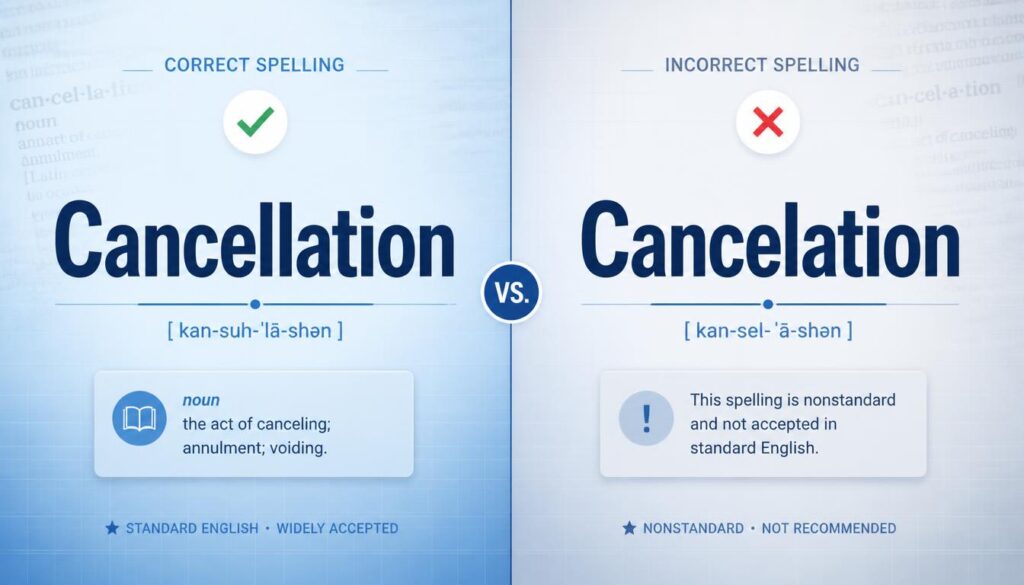
Cancellation, spelled with two L’s, is the correct and standard form in both British and American English. Cancelation, with a single L, is a recognized but rare American variant that most style guides, editors, and publications avoid.
If you only remember one thing from this article, remember that. Everything else is just the “why” behind it.
Cancellation vs Cancelation: What They Actually Mean
Before diving into spelling mechanics, it’s worth confirming that these two words mean exactly the same thing. There’s no hidden nuance here, no subtle shade of meaning that separates them.
Both cancellation and cancelation refer to the act of calling something off. A flight, a subscription, a wedding, a dentist appointment you were dreading anyway — the word applies to all of it. They’re not two different words with overlapping meanings; they’re the same word, spelled two different ways.
Think of it a bit like “theater” and “theatre.” Same concept, same pronunciation, just a difference rooted in regional spelling habits.
Why Two Spellings Exist in the First Place
This is where things get genuinely interesting, and it traces back further than most people expect.
The Latin Root
The word comes from the Latin cancellare, meaning “to cross out” or “to make like a lattice” (picture the crisscross pattern you’d draw through text you’re striking out). This root traveled into Old French and eventually into English, carrying the double-L spelling with it.
Noah Webster’s Reforms
In the early 1800s, American lexicographer Noah Webster set out to simplify English spelling for American readers. He’s the reason Americans write “color” instead of “colour,” and “center” instead of “centre.” Webster also pushed for single-consonant spellings in many verb forms, which is why American English uses canceled and canceling, while British English keeps cancelled and cancelling.
You’d expect that same logic to carry over to “cancellation,” giving us “cancelation.” And in a small number of cases, it did — hence the variant exists at all. But it never caught on the way Webster’s other reforms did.
Why the Double-L Version Won Anyway
Here’s the twist: even in the U.S., where Webster’s simplified spellings usually stuck, cancellation kept its double L. Language doesn’t always follow logic cleanly, and this is a good example of a spelling reform that simply didn’t take hold for one particular word, even as it succeeded for related ones like “canceled.”
Editors and grammarians generally chalk this up to familiarity. By the time American publishing houses standardized their style guides, “cancellation” had already become the dominant printed form, and once a spelling gets that entrenched, it’s very hard to dislodge.
The Grammar Rule Behind the Double L
If you want a rule you can actually apply elsewhere, here it is.
Doubling Consonants Before a Suffix
In English, when a word ends in a single consonant preceded by a single vowel, and you’re adding a suffix that starts with a vowel, you often double that final consonant. This keeps the pronunciation of the preceding vowel short and clear.
- travel → traveller / traveling
- model → modelled / modeling
- cancel → cancelled / canceling
This is why you’ll see inconsistency even within a single English variant — British English tends to double the consonant more consistently, while American English is more selective about when it applies the rule.
Cancellation follows the doubling pattern from its Latin and French origins, which is part of why it resisted Webster’s simplification even as “canceled” embraced it.
Cancellation vs Cancelation: A Side-by-Side Comparison
| Feature | Cancellation | Cancelation |
|---|---|---|
| Spelling | Two L’s | One L |
| Standard in British English | Yes | No |
| Standard in American English | Yes | Rarely used |
| Recommended for formal writing | Yes | No |
| Frequency in real-world use | Very common | Uncommon |
| Recognized in major dictionaries | Yes | Yes, listed as variant |
The takeaway from this table is simple: cancellation isn’t just “more correct,” it’s dramatically more common. If you polled a hundred professional editors, the overwhelming majority would tell you to avoid “cancelation” entirely, regardless of which side of the Atlantic you’re writing for.
Scenario Examples: Seeing the Words in Context
Reading a rule is one thing. Seeing how it plays out in real writing makes it stick.
Scenario 1: A Customer Service Email
Using “Cancellation” (Recommended)
Subject: Confirmation of Your Booking Cancellation
Hi Sarah,
This confirms the cancellation of your spa appointment scheduled for Friday at 2 PM. Your deposit will be refunded within 3–5 business days.
Thank you for letting us know in advance.
Warm regards, The Booking Team
Using “Cancelation” (Technically Acceptable, But Unusual)
Subject: Confirmation of Your Booking Cancelation
Hi Sarah,
This confirms the cancelation of your spa appointment scheduled for Friday at 2 PM. Your deposit will be refunded within 3–5 business days.
Thank you for letting us know in advance.
Warm regards, The Booking Team
Notice something? The second version isn’t wrong exactly, but it feels slightly off, like a typo that somehow slipped past spellcheck. That’s the instinct most native English readers will have, even if they can’t articulate why.
Scenario 2: A Company Policy Document
Imagine you’re drafting a cancellation policy for a small business. Here’s how it might read:
“Customers may request a cancellation up to 24 hours before their scheduled appointment without penalty. Cancellations made within 24 hours will incur a 50% service charge.”
This is the kind of formal, legally-adjacent language where consistency really matters. Using “cancelation” here, even once, would look like an inconsistency or an error to most readers, especially anyone trained to spot grammar slips in official documents.
Scenario 3: Everyday Conversation via Text
“Ugh, just got the cancellation notice for my flight. Rebooking now.”
In casual writing, either spelling would technically be understood. But even in texts and social posts, most native speakers instinctively type “cancellation” without a second thought, simply because it’s the version they’ve seen a thousand times over.
Scenario 4: Academic or Legal Writing
“The court upheld the cancellation of the contract on the grounds of mutual breach.”
Legal and academic writing tends to be the strictest environment for spelling conventions. Style guides used in these fields, including the Chicago Manual of Style and most legal writing handbooks, consistently favor cancellation.
Before and After: Spotting the Difference
Sometimes the clearest way to internalize a rule is to see a sentence corrected in real time.
- Before: “Please confirm the cancelation of my membership.”
- After: “Please confirm the cancellation of my membership.”
- Before: “We regret to inform you of the cancelation of tonight’s event.”
- After: “We regret to inform you of the cancellation of tonight’s event.”
Read both versions aloud. The second one in each pair simply reads more naturally to most English speakers, and that’s not a coincidence. It’s exposure. We recognize “correctness” partly through pattern familiarity, and cancellation has vastly more real-world exposure baked into it.
Common Mistakes People Make With This Word
Mistake 1: Assuming “Cancelation” Is the British Spelling
This is a surprisingly common mix-up. People assume that because American English simplifies some double letters, “cancelation” must be the American form and “cancellation” the British one. In reality, both British and American English standardize on the double-L spelling. The confusion likely comes from other Webster-era changes like “canceled” vs “cancelled,” where the split genuinely does follow that pattern.
Mistake 2: Switching Spellings Mid-Document
If you’re writing a longer piece, whether it’s a report, an email chain, or a policy page, consistency matters more than most people realize. Switching between “cancellation” and “cancelation” partway through a document reads as careless, even if both technically pass a dictionary check.
Mistake 3: Treating “Cancelation” as a Typo
To be fair to anyone who’s used it, “cancelation” isn’t a typo. It’s listed in Merriam-Webster as a legitimate, if minor, variant. The mistake isn’t in using a word that doesn’t exist; it’s in choosing the less recognized option when a more universally accepted one is right there.
Related Word Pairs That Follow the Same Pattern
If this spelling debate feels oddly familiar, that’s because it belongs to a small family of words where American and British English diverge over consonant doubling:
- canceled vs cancelled
- canceling vs cancelling
- canceler vs canceller
- traveled vs travelled
- modeling vs modelling
Interestingly, cancellation doesn’t follow this British/American split the way its shorter relatives do. It’s the odd one out, standardized across both dialects, which is exactly why it trips people up.
Synonyms Worth Knowing
If you’re writing something formal and want to avoid repeating “cancellation” five times in one paragraph, a few solid alternatives include:
- Revocation — often used in legal or official contexts (revocation of a license)
- Termination — common in contracts and employment (termination of an agreement)
- Annulment — typically reserved for marriages or formally voided agreements
- Abolishment — used for laws, policies, or systems being ended
None of these are perfect one-to-one substitutes, so choose based on context rather than treating them as interchangeable.
Where You’ll See This Word Most Often
Certain phrases pair with “cancellation” so frequently that they’ve become fixed expressions in everyday English:
- flight cancellation
- hotel reservation cancellation
- subscription cancellation
- cancellation policy
- cancellation notice
- last-minute cancellation
If you search any of these online, you’ll notice the double-L spelling dominates almost every result, from airline websites to hotel booking platforms to customer service templates. That consistency isn’t an accident; it reflects decades of standardized business writing.
So, Which Should You Actually Use?
Unless you’re following a specific in-house style guide that explicitly calls for “cancelation” (and these do exist in a handful of American publications), stick with cancellation. It’s universally recognized, professionally safe, and won’t raise eyebrows in any context, whether you’re writing a customer email, a legal notice, or a casual text message.
Final Thoughts
Spelling debates like this one rarely get resolved by memorizing a rule alone. They get resolved through repetition, seeing the correct form often enough that it starts to feel automatic. So the next time you’re drafting an email about a canceled flight or writing up a company policy, trust the version with two L’s. It’s the one that’s stood the test of time, survived a major spelling reform, and remained the clear favorite across both British and American English.
When in doubt, cancellation wins. Every time.